.jpeg)


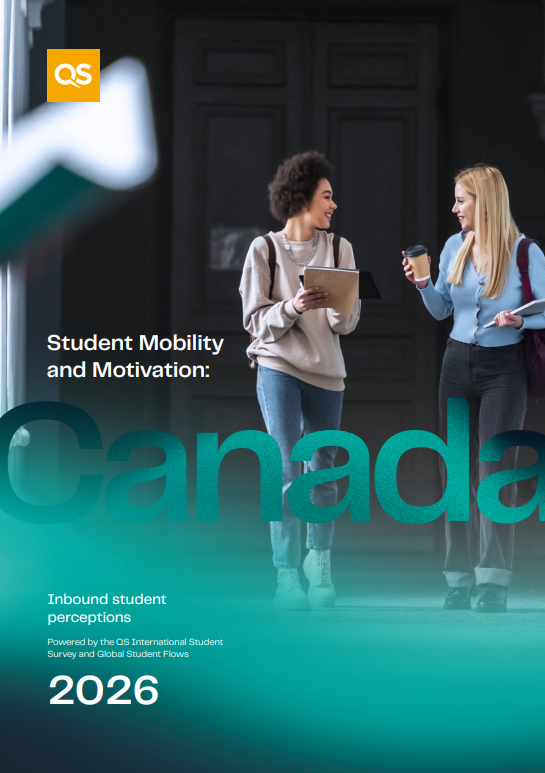
Student Mobility and Motivation: Canada

.png)
14 September 2026


Canada's international student recruitment market is set to shrink by 2030. Institutions needs to understand student preferences and motivations to retain market share, and drive new enrolments. Student Mobility and Motivation: Canada gives you the tools to understand:
Get an excerpt of our analysis below, or download the full report.
Business and Management continues to attract the largest share of interest, though its position has softened from 20% in 2022 to 16% in 2026. Engineering and Technology remains the second-largest subject area, holding relatively steady at 14% in 2026, only one percentage point below its 2022–2024 level. Computing, another core recruitment subject area, has also eased slightly, falling from 11% in 2024 to 9% in both 2025 and 2026.
The clearest growth story is in health-related study. Subjects allied to Medicine has risen from 7% in 2022 and 2023 to 10% in 2026. Medicine and Dentistry has also increased, from 7% in 2022 to 8% in 2026.
Most smaller subject areas remain highly stable, with little movement across the five-year period. Agriculture, Food and related studies holds at 4%, Architecture, Building and Planning at 2%, Communications and Media at 2%, Creative Arts and Design at 2%, and Physical Sciences at 2%.
For students looking to study in Canada, a welcoming destination is by far the most important factor. Fortunately, Canada is strongly associated with a good quality of life, and work opportunities, and rarely seen as discriminatory or dangerous. There are interesting movements around value and access - affordability has weakened as a motivator, with affordable cost of living falling from 48% to 43%, while affordable cost of studying has declined from 47% to 41%.
The clearest positive shifts are linked to outcomes and networks. The share selecting “it will help me build a network of connections” has increased from 36% to 40%. Graduate employment options have also recovered to 40% after dipping in 2024.