


The 16th edition of the QS World University Rankings by Subject is now live. This year’s analysis evaluates more than 21,000 academic programmes offered by around 1,900 institutions across 100 countries. The Rankings span 55 individual disciplines grouped into five broad faculty areas.
The top 10 institutions in the QS World University Rankings by Subject 2026
Below are the leading universities across the five broad subject areas featured in the QS World University Rankings by Subject 2026. Spanning Arts & Humanities, Engineering & Technology, Life Sciences & Medicine, Natural Sciences, and Social Sciences & Management, these Rankings highlight the institutions performing strongest across the world’s major academic disciplines.
Arts and Humanities
Engineering and Technology
Life Sciences and Medicine
Natural Sciences
Social Sciences and Management
QS World University Rankings by Subject 2026 results analysis
The headlines
- Northern America is the most represented region, with the highest total number of ranked subjects.
- Eastern Asia has the most new entries, including both newly ranked institutions and newly ranked subjects.
- Southern Asia is the most improved region proportionally, with the largest share of subjects moving up in the rankings.
- Computer Science & Information Systems and Medicine are the most widely ranked subjects globally.
- While Computer Science & Information Systems records the highest number of upward movements overall, Linguistics shows the largest proportional improvement.
- Data Science and Artificial Intelligence is the subject area with the most new entries.
.webp)
Global trends
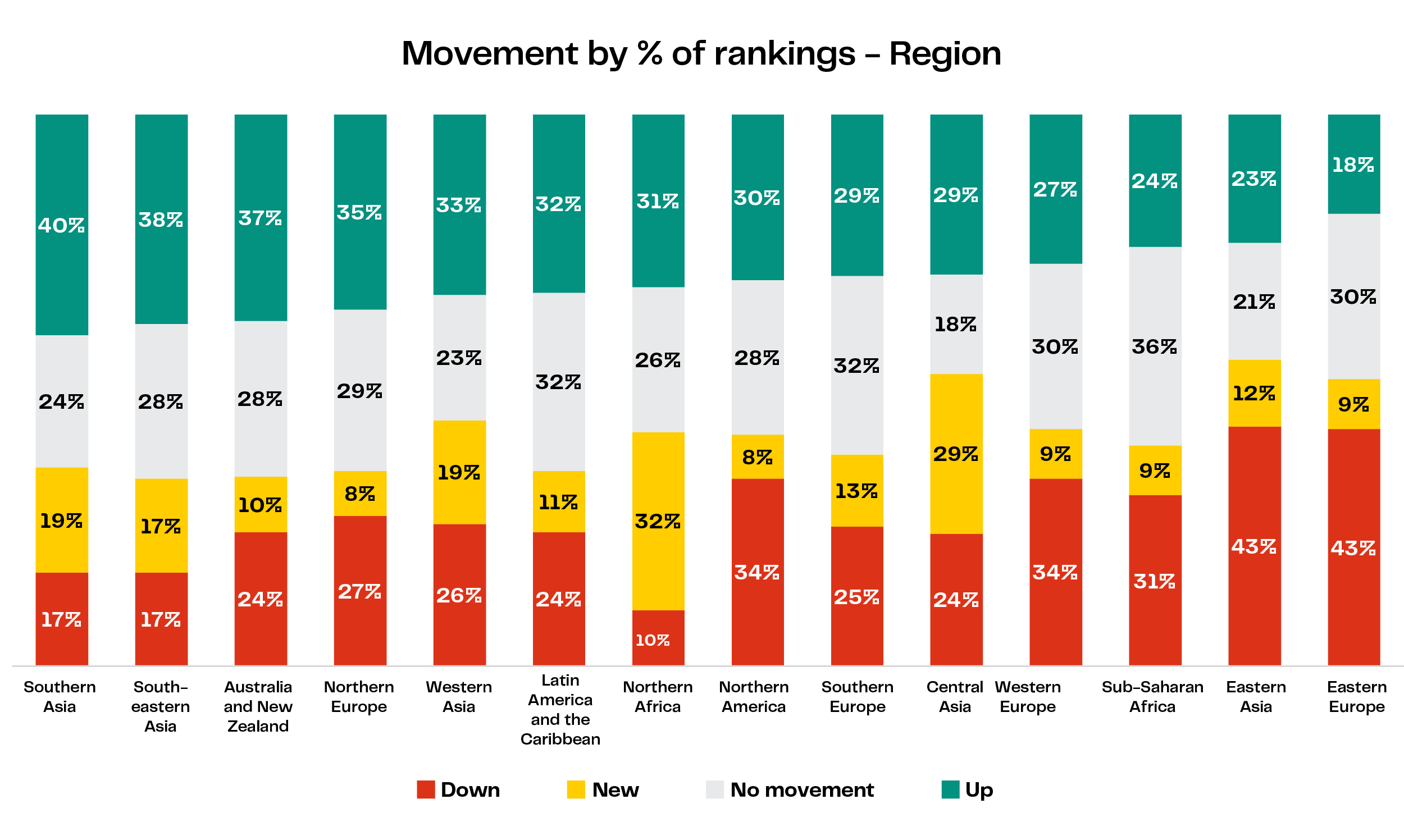
The regional distribution of ranking movement in the QS World University Rankings by Subject 2026 highlights continued growth across several emerging higher education systems. Southern Asia records the highest share of institutions improving their position (40%), followed by South-eastern Asia (38%) and Australia and New Zealand (37%), indicating strong upward momentum across the Asia-Pacific region. Latin America and the Caribbean shows a relatively balanced pattern of movement, while Northern Africa stands out for its high proportion of new entries (32%), pointing to increased participation in the rankings.
In contrast, more established regions such as Eastern Europe and Eastern Asia record the largest share of institutions moving down the rankings (both 43%), while Western Europe and North America also see notable downward movement.

Key headlines by subject
Arts and Humanities
- 3450+ subjects ranked
- Linguistics – most improved subject
- 490+ new subject entrants
- Australia and New Zealand – most improved region (35%)
- 1000+ upward moves
Engineering and Technology
- 3730+ subjects ranked
- Computer Science and Information Systems – most improved subject
- 470+ new subject entrants
- Southern Asia – most improved region (45%)
- 1150+ upward moves
Life Sciences and Medicine
- 4000+ subjects ranked
- Biological Sciences – most improved subject
- 430+ new subject entrants
- Northern Africa – most improved region (43%)
- 1210+ upward moves
Natural Sciences
- 4670+ subject rankings
- Chemistry – most improved subject
- 370+ new subject entrants
- Central Asia – most improved region (50%)
- 1430+ upward moves
Social Sciences and Management
- 5480+ subjects ranked
- Economics and Econometrics – most improved subject
- 640+ new subjects
- Southern Asia – most improved region (41%)
- 1650+ upward moves

.jpeg)


.png)


.jpg)