
.jpeg)


UK international student recruitment: Navigating a less predictable market

26 August 2026


We spoke to student recruitment leaders about how they would describe the market at the moment and there is a clear theme.
That sense of unpredictability is not a contradiction of the UK’s wider strength. At national level, the outlook for international recruitment remains positive. Student demand is still significant, the UK continues to be one of the world’s most recognised study destinations and long-term enrolment forecasts point to continued growth. The challenge is that this growth is no longer being felt evenly by every institution.
QS Global Student Flows forecasts UK international student enrolments to grow by around 3.5% annually to 2030, ahead of the other traditional ‘Big Four’ destinations. But that headline number also shows a changed market, with growth expected to be below the 5% forecast for continental Europe and well below the 11% annual growth recorded between 2019 and 2022.
This is the central tension for UK universities. The national picture is one of resilience, but, at the institutional level, the picture is nuanced. The Office for Students estimates that, without mitigating action, 124 higher education providers in England face a deficit in 2025-26. At the same time, QS analysis of international student FTE data from the QS World University Rankings suggests aggregate growth is increasingly concentrated among the Russell Group.
Across the 2017–2027 editions, the median Russell Group university increased its international student population from 6,625 to 9,932 FTE, a rise of 49.9%. Over the same period, the median across all UK universities fell from 3,635 to 3,330, a decline of 8.4%. In other words, the typical Russell Group institution expanded while the typical institution in the wider market contracted.
In 2017, the Russell Group median was 82% above the all-UK median; by the 2027 edition of the QS World University Rankings, it was 198% higher. That pattern suggests a flight to perceived quality, where internationally mobile students are increasingly favouring institutions with stronger global recognition, research reputations and established brands. For less prominent providers, a growing UK market can therefore still feel like a shrinking addressable market.
QS Global Student Flows shows why the opportunity is becoming harder to capture. Growth is still present, but it is becoming more uneven by source market, making institutional planning less predictable.
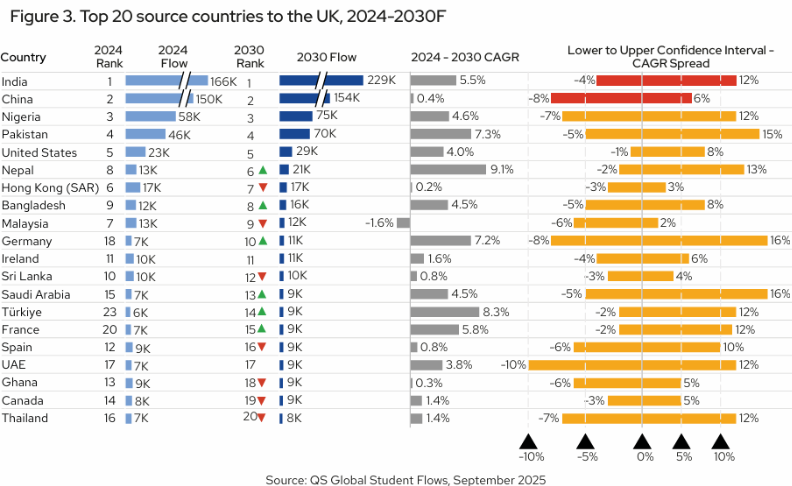
India and China are expected to remain the UK’s two largest sources of international students. Indian enrolments are forecast to recover following recent declines, although growth is expected to be slower than in the years following the introduction of the Graduate Route. Chinese enrolments are expected to remain broadly flat, influenced by domestic economic pressures and the improving quality of universities in China and across the wider Asia Pacific region.
Elsewhere, the picture looks different again. Africa is expected to provide stronger long-term growth, supported by younger populations and expanding middle classes, while Southeast Asia is also expected to contribute to future demand.
This puts universities in a challenging position. One institution may see strong demand in a priority market while another faces declining applications from the same region. A subject that has historically recruited well may begin to soften while another starts to grow. The experience described by recruitment leaders as “a new challenge every day” is understandable in that context. There are still opportunities, but fewer markets or programmes can be assumed to behave as they have in previous cycles.
If Global Student Flows explains where future demand may come from, the International Student Survey helps explain how students are deciding between destinations and institutions.
58% of UK-bound students say high-quality teaching is an important factor when choosing a country, while 52% prioritise a welcoming environment for international students and 40% look for good graduate employment opportunities.
These are considerable advantages for UK higher education, especially in a market where reputation and perceived quality are becoming more important. But the same data also points to a more demanding student decision-making process.
Students are also paying close attention to cost, however. 34% prioritise affordable tuition fees and 30% affordable living costs, while 59% perceive the UK to be expensive. Only 10% describe it as affordable.
For universities, this makes the value proposition more important. Academic reputation remains a major strength, but students are also considering the quality of the experience, future career opportunities and the wider return on investing in a UK degree.
This is particularly visible with regards to employability. QS International Student Survey data suggests students are attaching greater importance to the career value of their study decision, while there is clear pressure on the UK’s employer reputation performance.
In the Student mobility and motivation: UK, we found that the importance of good graduate employment opportunities has risen by four percentage points since 2022. The opportunity to build a network of connections has risen by a similar amount.
There are signs that UK universities have some work to do here. The median Employer Reputation rank of UK institutions has fallen by more than 150 positions since 2017, according to analysis in Global Student Flows: UK report.
For student recruitment teams, employability messaging therefore has a growing role to play. Information about industry partnerships, placements, graduate destinations and career development can help students understand what studying at an institution might mean beyond the degree itself. In a more concentrated market, this evidence can also help institutions outside the most globally recognised brands make a clearer case for why students should choose them.
The strongest examples are likely to be specific. Students can see the difference between broad claims about career prospects and evidence of the employers students work with, the experiences built into a programme and the outcomes achieved by previous graduates.
This focus on employability also comes as students are considering more institutions – half of UK-bound institutions are considering, or have applied to, five or more universities. A positive national outlook does not mean individual universities can rely on passive demand.
Students are also increasingly expect institutions to respond quickly. The proportion expecting a personal response within one day continues to rise, while fewer students now regard three days as an acceptable waiting time. In 2026, 8% more students expect to know the outcome of their application within 24 hours than in 2022.
That places greater pressure on recruitment and admissions teams, particularly at institutions competing for attention in a larger consideration set. Students may still be interested in the UK, but institutions increasingly need to work harder to remain visible, responsive and relevant throughout the decision-making process.
It also means the recruitment experience itself can influence student choice. When several universities are under consideration, timely and relevant communication can help maintain a student's interest through what may be a long decision-making process.
That decision-making process is also taking place across a wider mix of channels. Official university websites remain the most important source of information for UK-bound students, followed by online search and rankings, but the balance between channels is changing.
The importance of social media has increased by eight percentage points since 2022, the largest increase of any information source in the QS International Student Survey. More than 50% of UK-bound students use Instagram when researching study decisions, while agents and consultants are also becoming more relevant.
Students may encounter a university through social media, compare its rankings, visit programme pages, speak to an agent and contact admissions before making a final decision. The challenge is keeping those different parts of the experience consistent. The messages students encounter about cost, employability, academic quality and student life need to hold together across channels, while remaining clear, accurate and defensible in a more demanding compliance environment.
There is good reason for the words recruitment leaders use to describe their work: “dynamic”, “fast-paced”, “challenging” and “unpredictable”.
The overall outlook for the UK is stronger than for several of its traditional competitors. Its universities retain considerable academic reputation, demand for a UK education remains significant and long-term forecasts point to continued growth.
But the data from Global Student Flows and the International Student Survey shows why that positive outlook does not remove pressure from individual universities. Growth is uneven across source markets and increasingly concentrated within the Russell Group. Affordability is prominent in student perceptions. Employability and visa options are becoming more important. Students are comparing more institutions, using more channels and expecting faster communication. Institutions are also operating in a more demanding compliance environment, where recruitment communications need to be clear, consistent and defensible across every channel students use.
That is asking more of recruitment teams. It requires institutions to keep a closer eye on individual markets and subjects, understand how student priorities are changing and adjust recruitment activity when the evidence points in a different direction. And then there is the renewed rigour of the Basic Compliance Assessment, to add a final challenge.
Creativity, one of the words used by Marie Ennis, Director of Strategic Communications at the University of London to describe the sector today, will be part institutional resilience. So will good data, responsive teams and a willingness to reconsider approaches that may have worked well only a few years ago.
The coming years still offer considerable opportunity for UK international recruitment. The difference is that opportunity will need to be earned institution by institution, market by market and student by student.