.jpeg)

QS World Future Skills Index 2027 - France Briefing



9 July 2026


Download the full briefing for the complete analysis. Read a few key findings below.
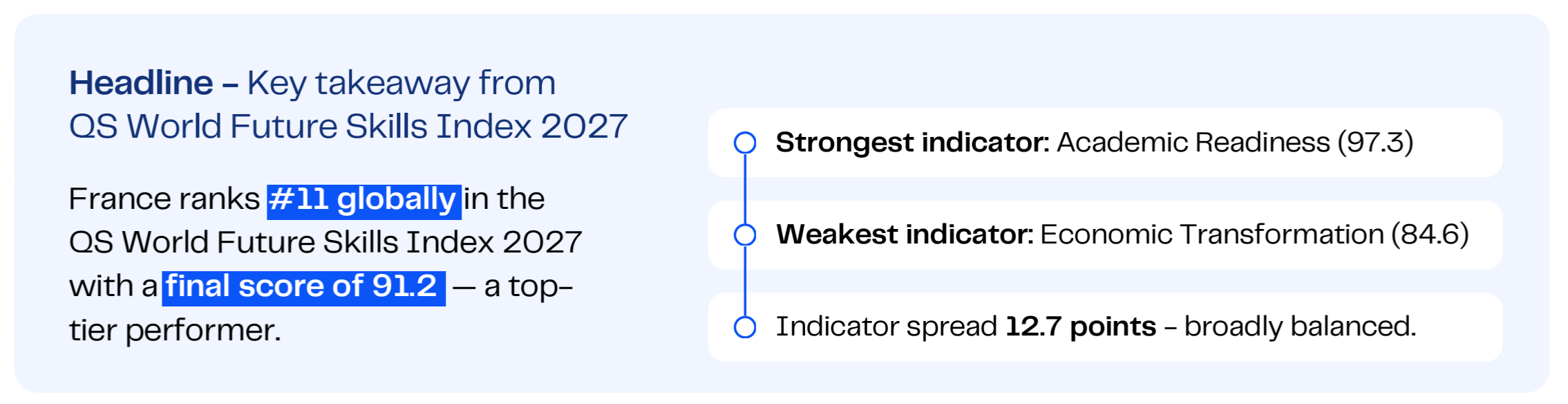
The France profile shows a highly balanced performance across the four indicators (spread of 12.7 points). Its strongest contribution comes from Academic Readiness (97.3, rank #5), while Economic Transformation is the relative weak spot (84.6, rank #31).
The indicator profile suggests the economy has built strong human-capital and academic foundations, but underlying economic conditions may constrain its ability to fully translate those foundations into realised workforce transformation.
Peer positioning insight - comparison against regional and income-group cohorts
In its regional cohort (Europe & Central Asia), France ranks #6 of 37 eligible economies. Its Final Score of 91.2 compares to a regional median of 71.4 (+19.8 vs regional median).
In its income-group cohort (High-income countries), it ranks #10 of 47 eligible economies, with its Final Score +12.5 vs the income group median of 78.7.
The closest regional rival is Switzerland; the closest income-group rival is Singapore.
Closest 5 by Final Score within selected economy's region
Closest 5 by Final Score within selected economy's income group
The QS World Future Skills Index evaluates how effectively economies can develop, align, and apply skills in a fast-changing global economy. Rather than focusing on higher education only or labour markets in isolation, the Index measures how well higher education systems align with workforce needs in the age of AI.
As economies around the world adapt to the transformative impact of AI, both labour markets and higher education institutions face growing pressure to evolve. Covering 89economies, the Index assesses readiness to harness the opportunities created by AI through a talent-supply and talent-demand analysis. It combines QS’s proprietary data on university performance, jobs and skills, and AI transformation with internationally recognised indicators to provide a global benchmark of AI readiness.
France ranks 11th globally in the QS World Future Skills Index 2027 with a Final Score of 91.2. While Academic Readiness is France’s highest scoring indicator (97.3), it heavily relies on its Grandes Écoles. France is also set to struggle to absorb the highly skilled graduates it produces, with an Economic Transformation score of 84.6 (lower than the UK, Germany, the Netherlands and Spain).
As seen in the QS World University Rankings, the Grandes Écoles produce world-class engineers, mathematicians and administrators on resource bases comparable to elite international peers, while the open-access universities operate at far lower funding levels. The France 2030 agenda and the LPR, with its injection of €25bn into research by 2030, signal a sustained policy commitment to closing the skills, research-intensity and reindustrialisation gaps but the scale of the human-capital deficit - 400,000 additional advanced-technical workers needed by 2030 - substantially exceeds the current educational pipeline's delivery capacity.
France's QS World Future Skills Index profile shows a strong Academic Readiness, moderate-to-strong Future of Work performance, with a high AI Workforce Transformation Index score as a result of its services-heavy economy. The more variable Skills Alignment score highlights a mismatch between graduate output and labour market demand. QS Global Student Flows data projects over 500,000 international students in France by 2030 (up from 400,000 in 2023), positioning it to capture displaced demand as a secondary destination with more lenient visa policy. This strengthens its talent pipeline, but without better alignment to employer needs, its Economic Transformation remains constrained by low R&D intensity and structural unemployment.