
.jpeg)


QS World Future Skills Index 2027



24 June 2026


Mapping the global alignment between higher education systems and workforce needs.
The global job market is facing disruption unlike any economic event since the industrial revolution. AI is set to fundamentally transform the global economy, human occupational and skills priorities and ultimately the role of higher education in supplying world-class talent into labour markets. The QS World Future Skills Index 2027 shows that AI is not creating a uniform disruption. Instead, it is amplifying existing differences between economies. Those with strong alignment between higher education, workforce demand and economic strategy are pulling further ahead. Others are seeing skills gaps widen, even where overall investment remains high.
The United States sits at #1 in this year's Index with the leading Skills Alignment score, yet American employers still report critical gaps in the human skills necessary to maximise the gains from AI and graduate underemployment is rising. A strong supply of technical skills is no guarantee of demand for them.
This report identifies where economies are investing effectively in skills development, where the AI-augmentable vs automatable labour market composition can have the greatest impact on the future of work, and where there is alignment, or misalignment between industrial demand and higher education capabilities and skills supply.
Human skills remain the most sought-after capabilities among employers globally, according to the QS Global Employer Survey; however, gaps exist in human skills as much, or, in many cases, more than technical skills. The QS World Future Skills Index shows that higher education systems are struggling to equip graduates for a rapidly changing labour market, with employer demand for human skills and AI, digital and green-intensive skills often moving faster than universities can respond. This is not a challenge which universities can solve without a broader reset across higher education policy, funding, curriculum governance, institutional agility, and employer investment in workforce development and lifelong learning.
For example, India represents one of the most significant opportunities for higher education globally. It ranks fifth for Future of Work readiness (96.0), but eighteenth for Skills Alignment (82.7), evidencing a gap between labour-market transformation and the ability to produce job-ready graduates. As one of the world’s largest economies and higher education systems, India’s success in closing this gap will shape both its national growth trajectory and the global supply of skilled talent.
Government policy can play a pivotal role. India’s National Education Policy 2020 is an ambitious attempt to address this challenge, with reforms focused on curriculum flexibility, industry alignment, future-focused skills, and graduate employability at scale. TNE partnerships including branch campuses, and collaborative delivery models can help high-growth economies close skills gaps faster while strengthening global talent pipelines for economies facing persistent skills shortages.
No economy is insulated from AI-driven disruption, but advanced economies are better positioned to capture its benefits and mitigate labour-market displacement. Although early forecasts often predicted mass layoffs and widespread labour-market collapse, these results indicate that AI could generate net-positive economic outcomes, at least in the foreseeable future. Demand for higher-skilled, knowledge-intensive roles is expected to grow, while low-skilled and repetitive occupations remain most exposed to automation. The United Kingdom, United States, Australia, and Germany lead globally in the new QS AI Workforce Transformation Index not necessarily because they are adopting AI more rapidly, but because their economies are more concentrated in occupations where AI augments human capability rather than replacing it.
As labour-market demand shifts towards roles where human expertise remains central, the competitive advantage of economies and higher education institutions will depend on how effectively they prepare learners for AI-enabled work. Without intervention and investment in upskilling and reskilling, there is a significant risk that AI will exacerbate inequality, concentrating opportunities among workers with the skills to leverage AI while increasing displacement among those in lower skilled roles.
Strong higher education systems do not automatically translate into economic growth; impact depends on how effectively research, investment and industry are connected. The United Kingdom illustrates this clearly. It leads globally on Academic Readiness (100.0), yet its Economic Transformation score (90.2) lags behind, creating the widest gap among the top ten economies.
This reflects a broader pattern, where academic excellence provides the foundation, but translating talent and research into economic value depends on close coordination between government, industry and higher education. Where these links are strong, universities increase the commercial impact of their research, while industry gains access to more market-ready innovation, clearer intellectual property pathways and stronger collaboration.
Governments need to make long term, data-led strategic bets on the sectors where their economy and higher education system offers advantage and needs to support both the supply of talent and demand creation for talent, simultaneously. Failing to attract investment or incentivise R&D in emerging sectors limits an economy’s ability to translate research excellence into productivity, competitiveness, and long-term growth.
Employers increasingly perceive that higher education is not changing quickly enough to keep pace with the scale of workplace transformation. As Anthropic CEO Dario Amodei has argued, AI is entering a phase with societal and economic consequences comparable to the Industrial Revolution that will “test who we are as a species”. Our findings suggest that economic transformation is accelerating faster than talent development, as AI-driven shifts in labour-market demand outpace the evolution of higher education systems.
Leading economies on Future of Work readiness include the United Kingdom, United States, Australia, Switzerland, and Germany. Yet the weak relationship between AI workforce readiness and graduate skills supply points to a gap that will require rapid, coordinated action from higher education leaders, policymakers, and employers. Higher education institutions will need to undergo significant transformation to keep pace with AI-driven shifts in workforce demand. This will require faster adaptation of programme portfolios, curriculum content, and institutional operating models. However, universities must balance responsiveness with the academic quality, rigour, and governance standards that ensure long-term value for students and society. Yet the pace of technological change means that maintaining the status quo is not an option. To remain relevant and sustain their central role in talent development, research, and innovation, universities must embrace transformation with greater urgency. At the same time, governments pursuing AI, digital, and industrial transformation risk constraining growth if higher education systems cannot produce the required talent.
For smaller economies, scale has never been the primary route to competitiveness, a pattern clearly reflected in the QS World Future Skills Index 2027. The Netherlands ranks eighth, Switzerland 10th, and Singapore 12th, despite having much smaller higher education systems than the United States, United Kingdom, or Germany. Rather than competing across every discipline, they typically concentrate investment in areas aligned with existing and emerging economic strengths. Faculty and subject-level reputation will become increasingly important. As students focus more on course-to-career outcomes than institution-to-career outcomes, the strength of individual disciplines and programmes will play a greater role in attracting talent. Institutions with recognised excellence in high-demand fields will be best positioned to maintain relevance and competitiveness.
The top 25 economies in the QS World Future Skills Index are diverse in size, income levels and economic structure. They are not uniformly small, nor uniformly high-income, nor uniformly service oriented. The Balance Index (Figure A), calculated as the standard deviation of indicator scores, assesses the extent to which future skills ecosystems are balanced, with lower scores reflecting stronger alignment between skills readiness and market demand, and higher scores indicating an imbalance across the system.
Balance, rather than performance alone, may be the stronger predictor of an economy's ability to adapt to future disruption. Economies with the lowest Balance Index scores - Australia, the United States and Spain - combine strong overall performance with consistent results across all four indicators. This suggests that their talent systems are well-aligned with labour market demand and broader economic transformation needs. By contrast, less balanced economies are more vulnerable to disruption, as weaknesses in one part of the system can constrain performance elsewhere. In these cases, additional investment alone is unlikely to be sufficient. The greater challenge is achieving stronger alignment between demand-side requirements and supply-side capabilities, ensuring that workforce development keeps pace with evolving economic needs.
The QS World Future Skills Index evaluates how effectively economies can develop, align, and apply skills in a fast-changing global economy. Rather than focusing on higher education only or labour markets in isolation, the Index measures how well higher education systems align with workforce needs in the age of AI.
As economies around the world adapt to the transformative impact of AI, both labour markets and higher education institutions face growing pressure to evolve. Covering 89 economies, the Index assesses readiness to harness the opportunities created by AI through a talent-supply and talent-demand analysis. It combines QS’s proprietary data on university performance, jobs and skills, and AI transformation with internationally recognised indicators to provide a global benchmark of AI readiness.
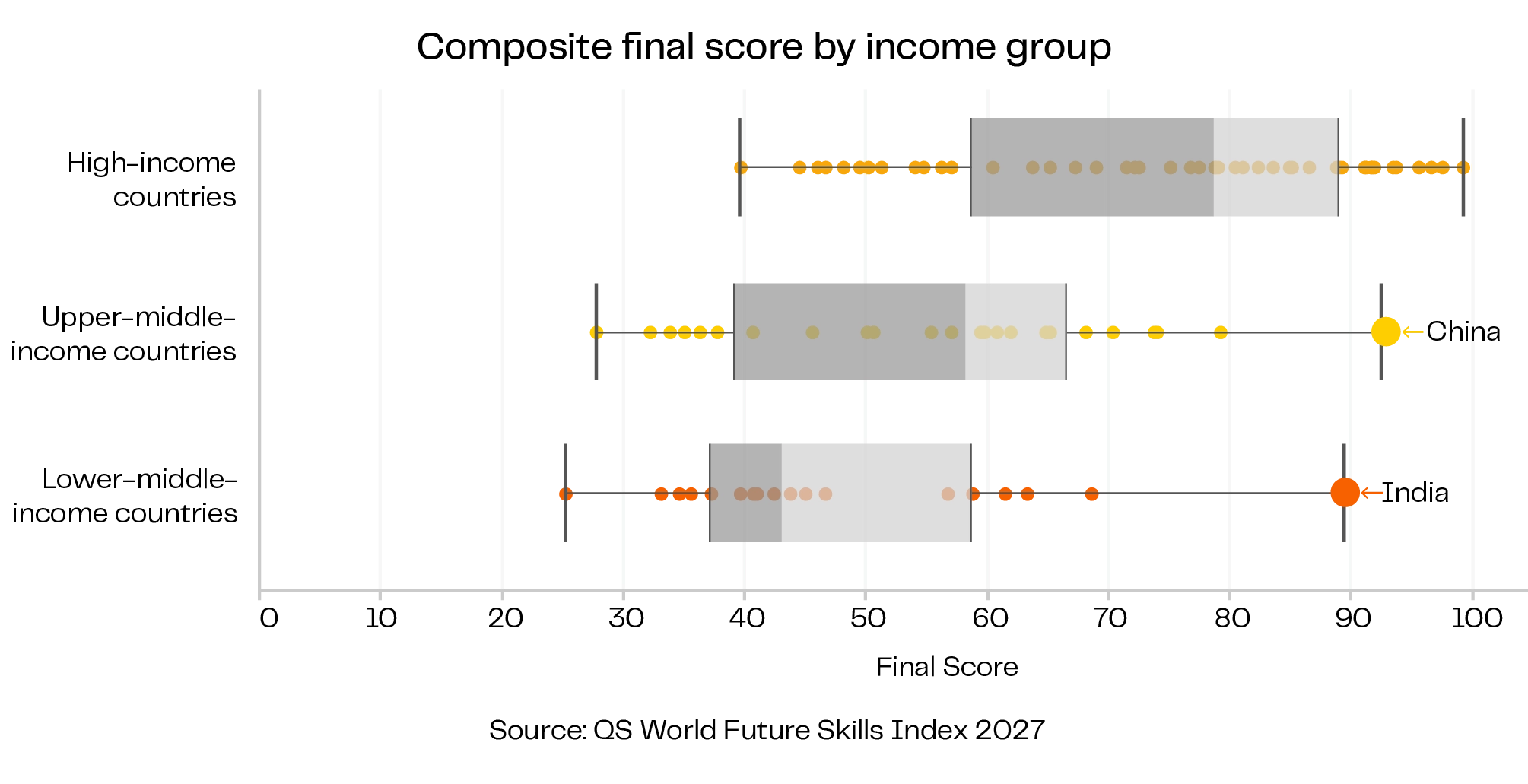
The headline rankings mask important differences. Once the 89 economies are broken down by region and by income group, two patterns become clear. First, regions reach similar overall scores through very different strengths. Europe leads on the quality of its universities and the strength of its economic foundations; while the Asia Pacific leads on how well its skills supply is matched to what employers actually demand.
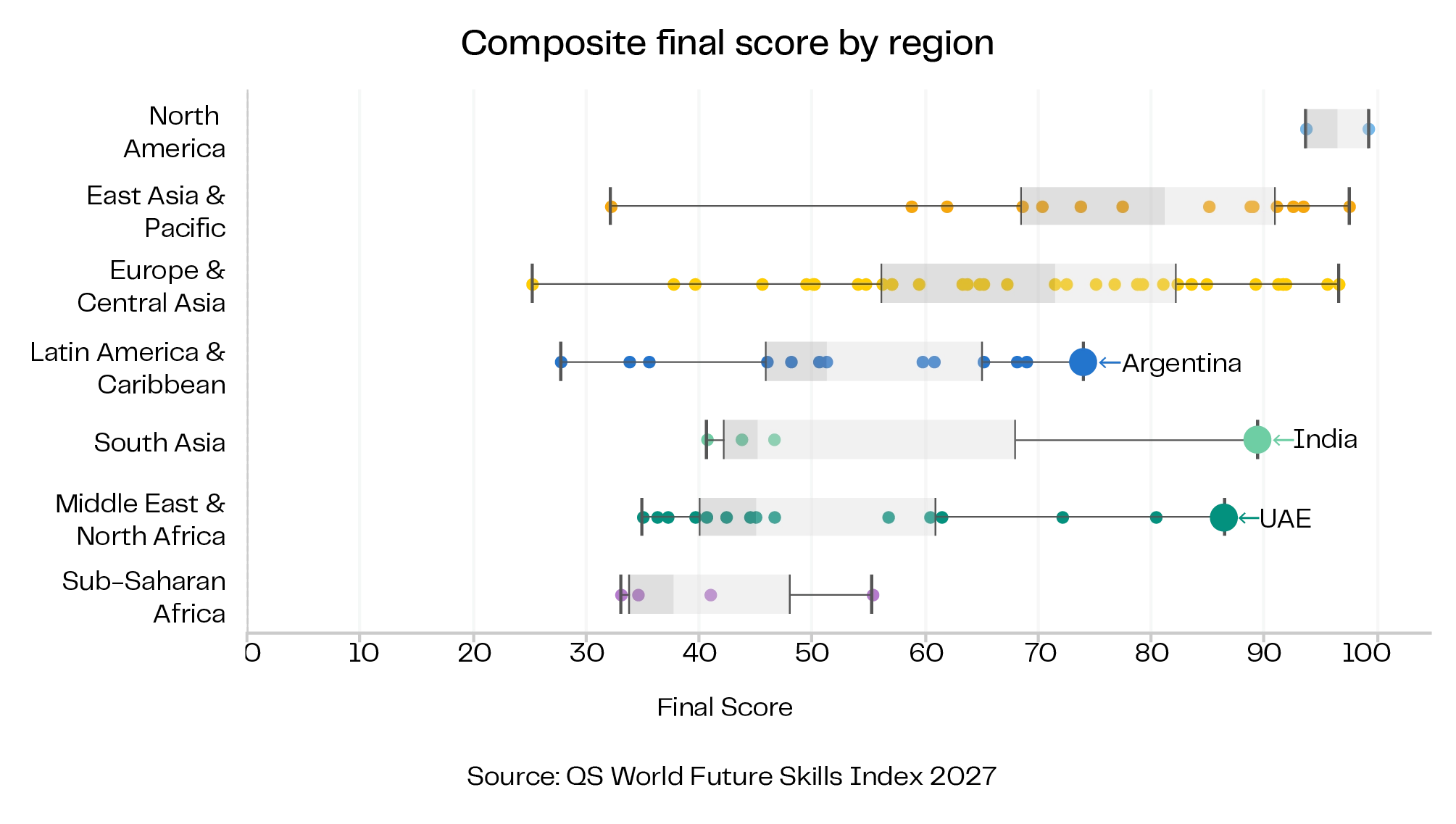
Europe and the Asia Pacific dominate the top quartile but reach similar headline outcomes via different means. Europe leans on its institutional indicators (Academic Readiness 81.0, Economic Transformation 84.1), reflecting a deep research-university base and large industrial capacity; Asia Pacific leans instead on Skills Alignment (77.2) and Economic Transformation (83.0), reflecting tighter alignment between employer demand and graduate output, particularly in East and South Asia. The two regions are achieving similar outcomes through different approaches: one driven by institutional strength and the other by market alignment.
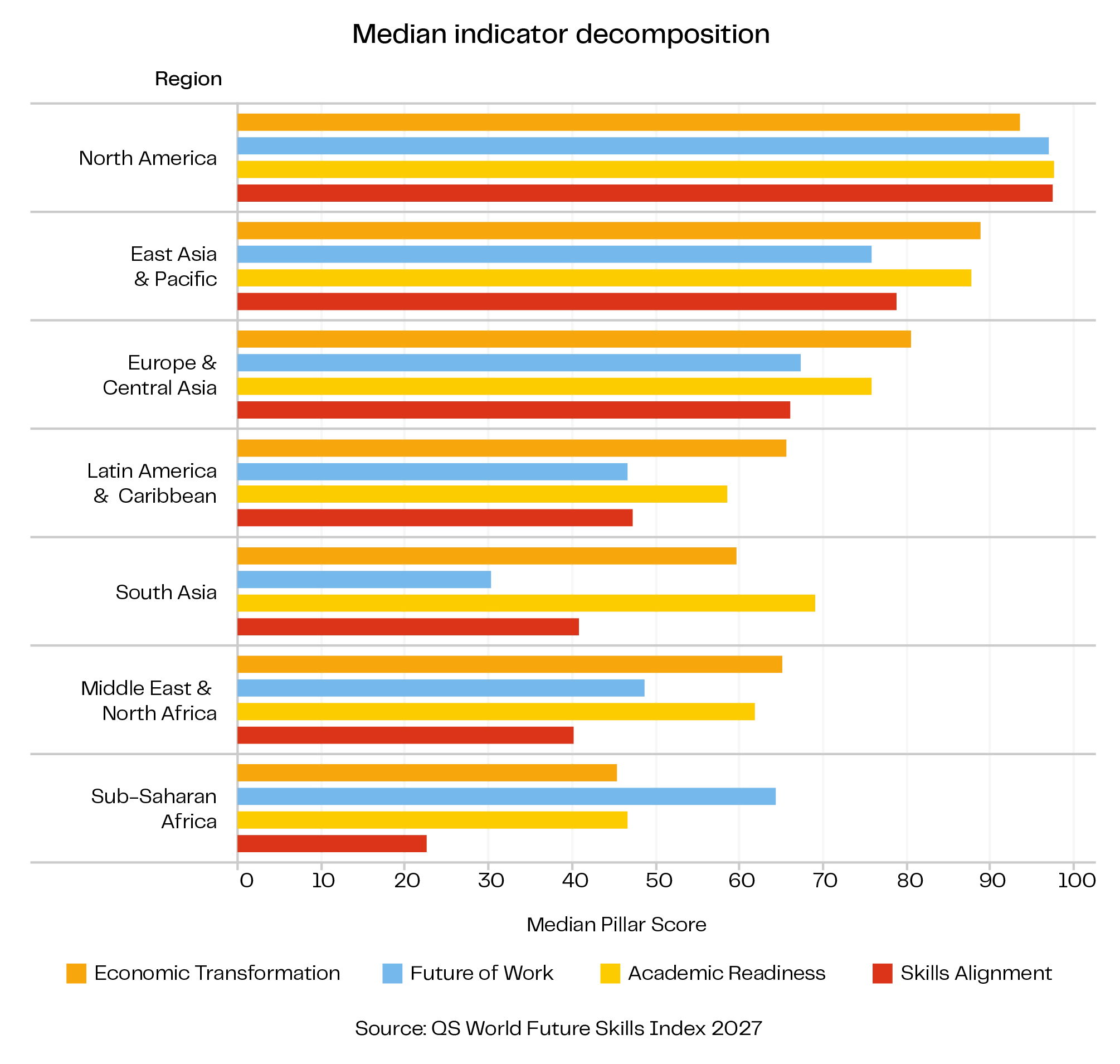
A similar trend appears when looking at Latin America and the Caribbean (LATAM), South Asia and the Middle East and North Africa (MENA). In these regions, median final scores are similar, but each region has unique strengths. LATAM and MENA’s highest median scores are in Economic Transformation, while South Asia’s strongest indicator is Academic Readiness. Different strengths can deliver similar outcomes, but each region still needs to fix its weakest link to stay competitive and achieve alignment between skills supply and demand.
Progression across income groups slows sharply as economies move up the distribution. Becoming a future-ready economy requires several conditions to come together at once; strong infrastructure, sustained investment, and a large pool of highly educated workers must all work in tandem to stop economic performance plateauing.
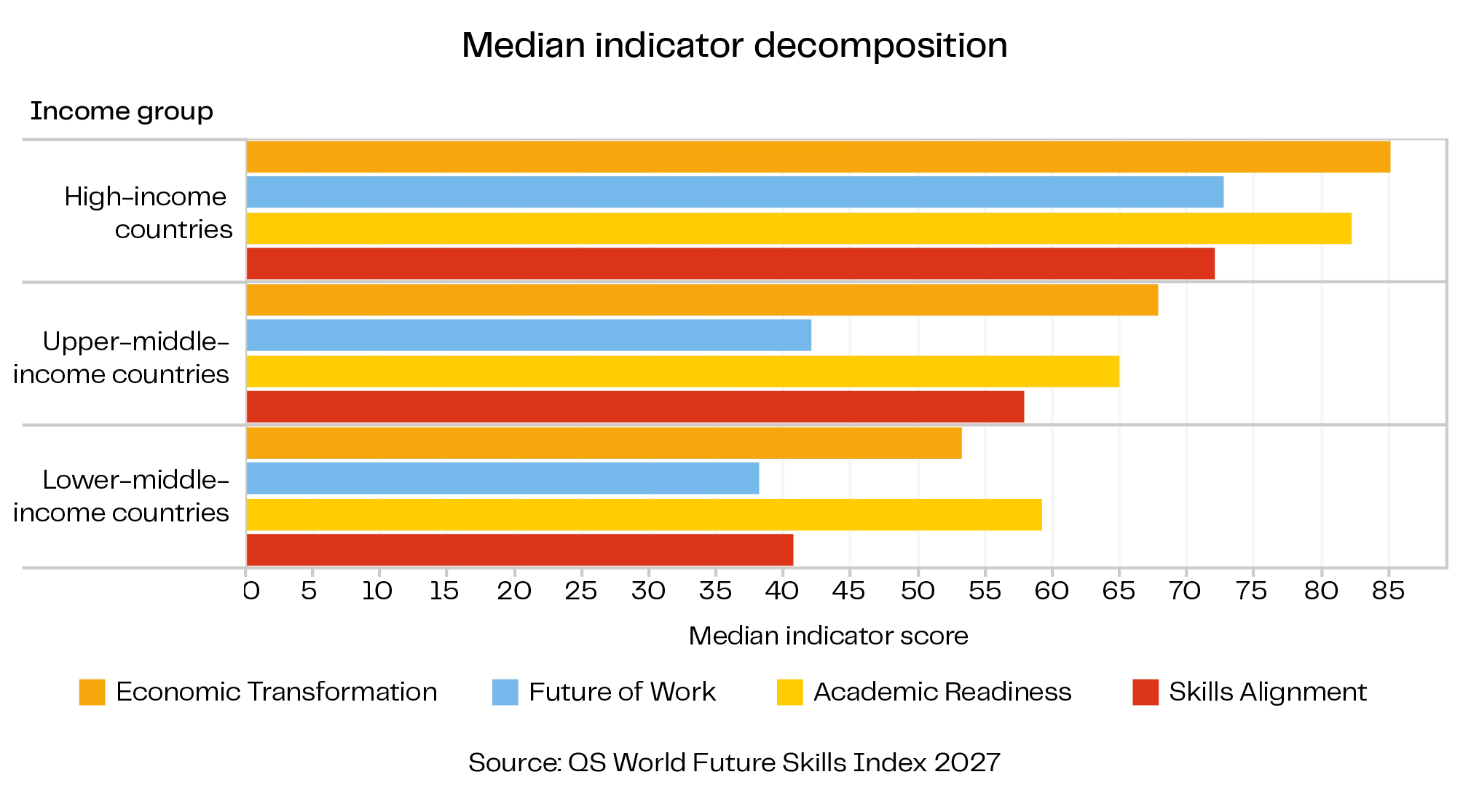
High-income economies cluster tightly at the top, while most lower-middle-income economies sit well below, with very few bridging the gap (Figure C). The divide is particularly pronounced in Future of Work readiness, where advanced economies have already shifted toward roles that benefit from AI, while others remain more exposed to automation. India stands out as a rare exception, highlighting both the scale of the opportunity, and the difficulty of sustaining it.
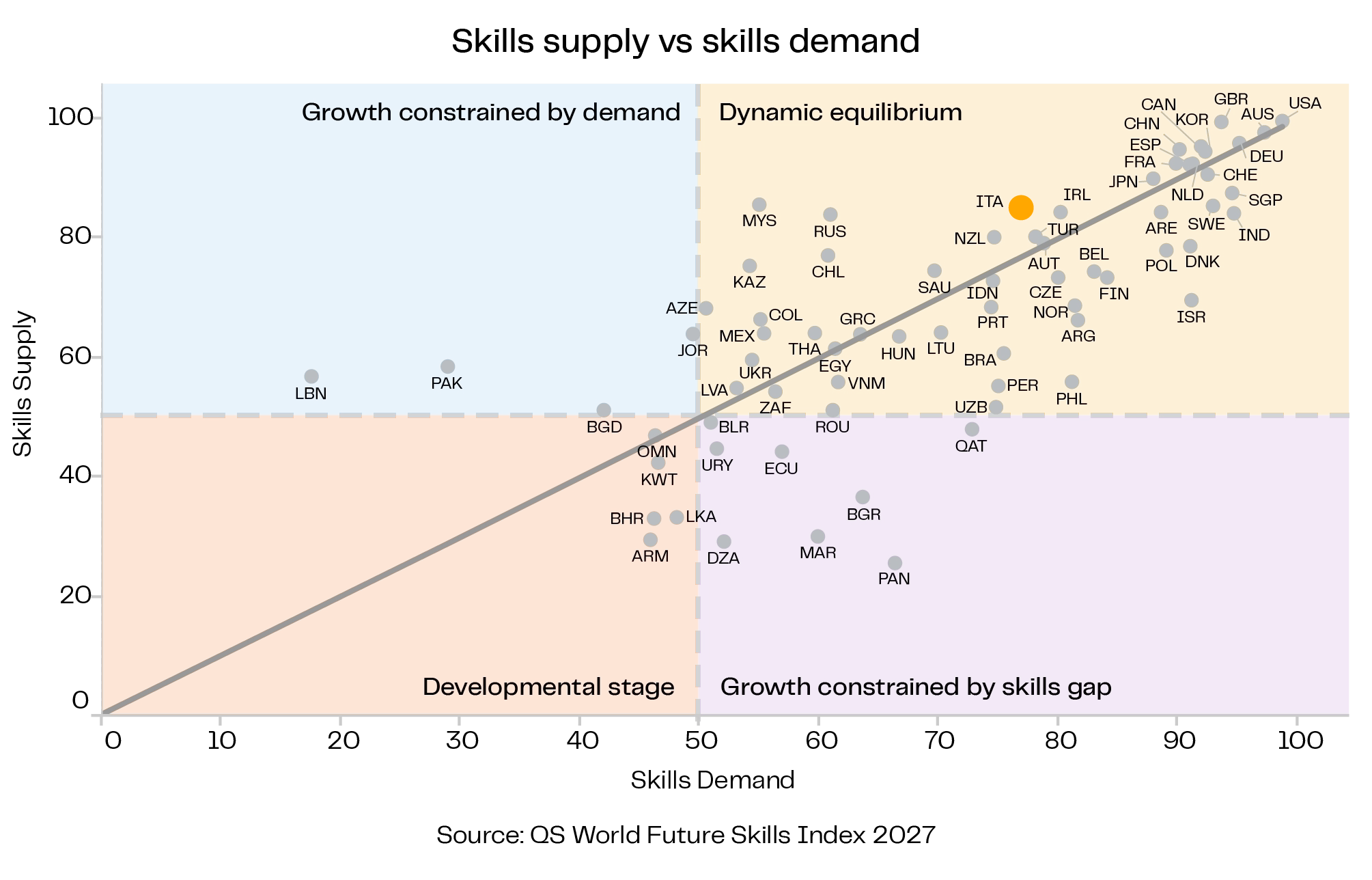
Economies above the equilibrium line, which represents the point where skills supply matches demand, tend to invest heavily in skills, universities and future industries, even where the wider economy is not yet able to absorb that talent. Italy illustrates this clearly, with the largest skills supply surplus among the top 25 economies, with strong graduate pipelines but a shortage of high‑value roles. The result is talent outflows, graduate underemployment and weaker productivity growth. While Italy’s higher education system retains significant research strength, the challenge now is to convert this into industrial innovation and economic value.
When the volume of graduates exceeds what the domestic economy can support, we could see outward migration, and weaker entry-level wages, as has been the case in Italy, other Southern European countries, and Latin America. By contrast, the most competitive systems combine high supply with strong demand, where employer needs keep pace with graduate output and reinforce continued investment in education. Elsewhere, some systems remain in a developmental stage, where both supply and demand are limited, while others face acute skills shortages, where employers are hiring for innovative job roles faster than education systems can adapt their teaching.






.jpg)