
.jpeg)


Global Student Flows | India



6 March 2026


India is entering a pivotal moment in global student mobility: inbound demand is projected to rise ~7% over the next five years, driven by fast-growing regional markets such as South Asia and Sub-Saharan Africa, while policy reforms under the Study in India programme and the National Education Policy 2020 are making the country more accessible and globally connected. The report examines how shifting outbound patterns, tightening visa routes in major Anglophone destinations, and intensifying skills pressures are reshaping India’s higher-education positioning - highlighting reputation, employability, and infrastructure capacity as the decisive factors that will determine whether India can scale sustainably and compete as a leading study destination and global skills hub through 2030 and beyond.
Get a snapshot of the insights below. Download the PDF for the full report.
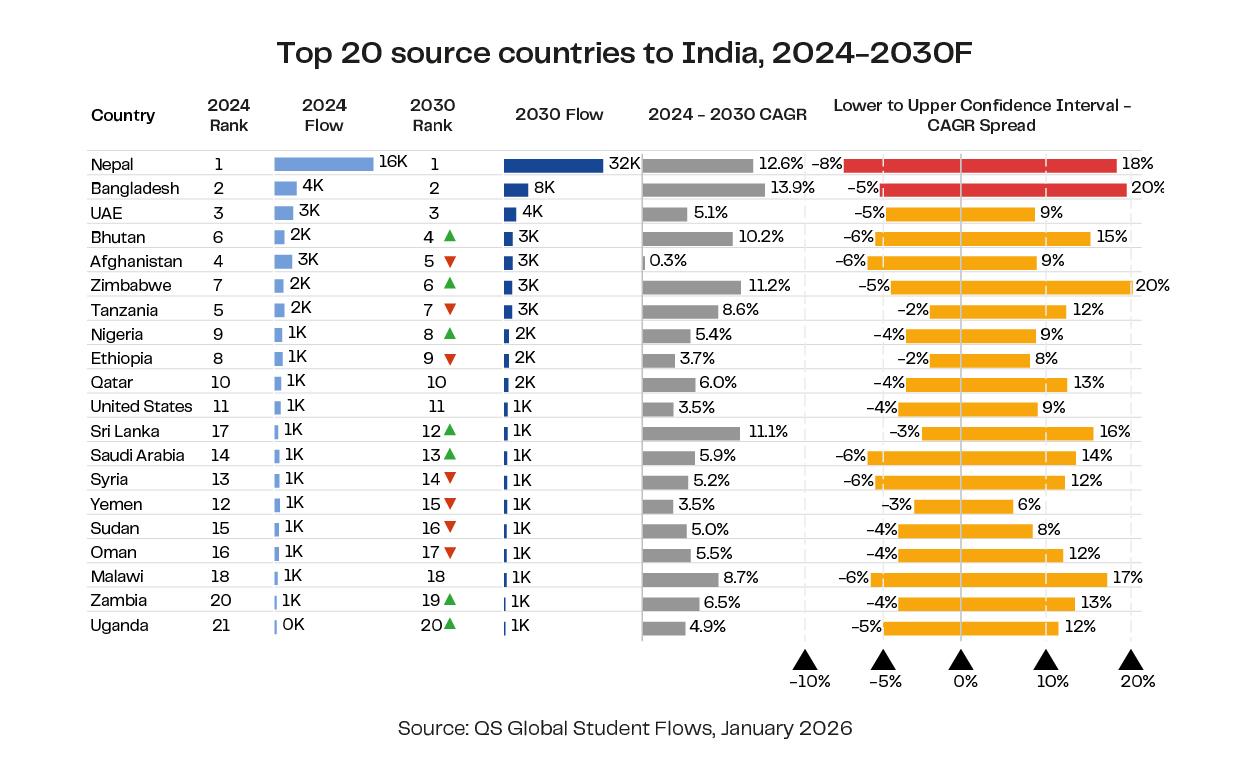
India is entering a pivotal phase in global student mobility, with inbound enrolments projected to grow by around 7% over the next five years. Regional demand is a major driver: South Asia is set to expand by 10% a year, while Sub‑Saharan Africa is forecast to grow by 5%, signalling a structural shift in where international students are looking for opportunity. Within this, Nepal stands out with expected growth of around 11% annually, and Zimbabwe is projected to surge by 13%, moving from India’s seventh-largest African source market to fourth by 2030.
This momentum is being accelerated by government policy. The Study in India programme has lowered financial and administrative hurdles, while reforms tied to the National Education Policy 2020, such as enabling foreign universities to establish local campuses and expanding seats for international students, are making India more accessible and globally connected. At the same time, affordability, English-medium delivery, and India’s proximity to major sending markets are making it newly competitive as Anglophone destinations tighten their visa routes.
Outbound flows remain substantial. India is still the world’s second‑largest source of international students, but the traditional ‘Big Four’ destinations are expected to see a small average decline (‑0.5%) in Indian enrolments through 2030, reflecting shifting policies abroad and growing openness elsewhere, including Germany, France and the UAE.
Labour market dynamics are an increasingly important backdrop. India faces major skills pressures: around 18 million Indians are leaving the country to work abroad, and a third of IIT graduates reportedly emigrate. Meanwhile, employers are rapidly demanding AI-, digital-, and green-skills capabilities. The National Education Policy 2020 aims to address these gaps through stronger vocational education, industry linkages, and flexible, multidisciplinary degree pathways. These reforms are designed to improve job readiness and keep more talent within the country, an issue closely tied to India’s ambitions as both a study destination and a global skills hub.
The QS International Student Survey findings underscores two decisive factors shaping student decision‑making: reputation and employability. More than 70% of Middle Eastern candidates considering India cite institutional reputation as an important influence, while 50% of all surveyed students want universities to communicate work placements and industry ties more clearly. These insights highlight the growing expectation that Indian institutions pair academic quality with credible pathways into employment.
Overall, India’s higher-education landscape is becoming more outward‑facing, better supported by policy, and increasingly attractive to students seeking quality, affordability, and regional relevance
The international higher education sector is undergoing real change. India’s ambition to attract more international students comes as other traditional student-sending markets position themselves as recruitment destinations, alongside this, major Anglophone countries are tightening visa routes and becoming more expensive. With a confluence of challenges, Indian institutions must be ready to face a variety of scenarios as they plan for 2030 and beyond.
While Indian institutions are making progress in their Employer Reputation, there remains a significant gap between institutional reputation and actual graduate employment outcomes. Students increasingly demand clear pathways to work placements and industry connections. This disparity risks undermining India’s attractiveness as a study destination if not addressed.
India’s goal to host 500,000 foreign students by 2047 is ambitious, but growth is limited by structural constraints: campus infrastructure, housing supply, and the need for adequate student support. Rapid expansion without addressing these bottlenecks could overburden urban systems and compromise the quality of the student experience.
India’s inbound student numbers are expected to grow by about 8% a year over the next five years from an estimated base of 58,000 in 2025, a contrast to the tightening seen across major anglophone destinations. The outlook is being lifted by stronger regional demand, particularly from South Asia and Sub-Saharan Africa, which are projected to expand by about 11% and 6% annually from 2024 to 2030. Government policy is central to this shift. The “Study in India” programme lowers financial and administrative barriers, while India’s relative affordability, English-medium delivery, and proximity to major sending markets strengthen its competitive position at a time when anglophone destinations are raising visa hurdles and becoming more expensive.
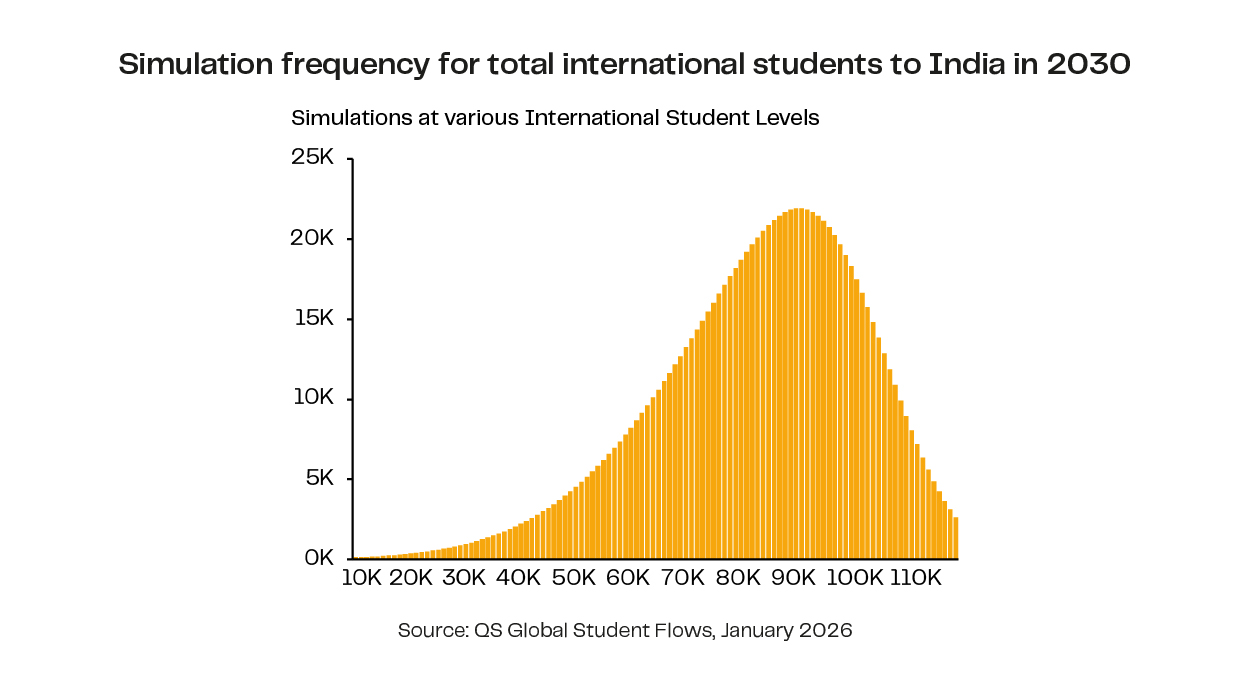
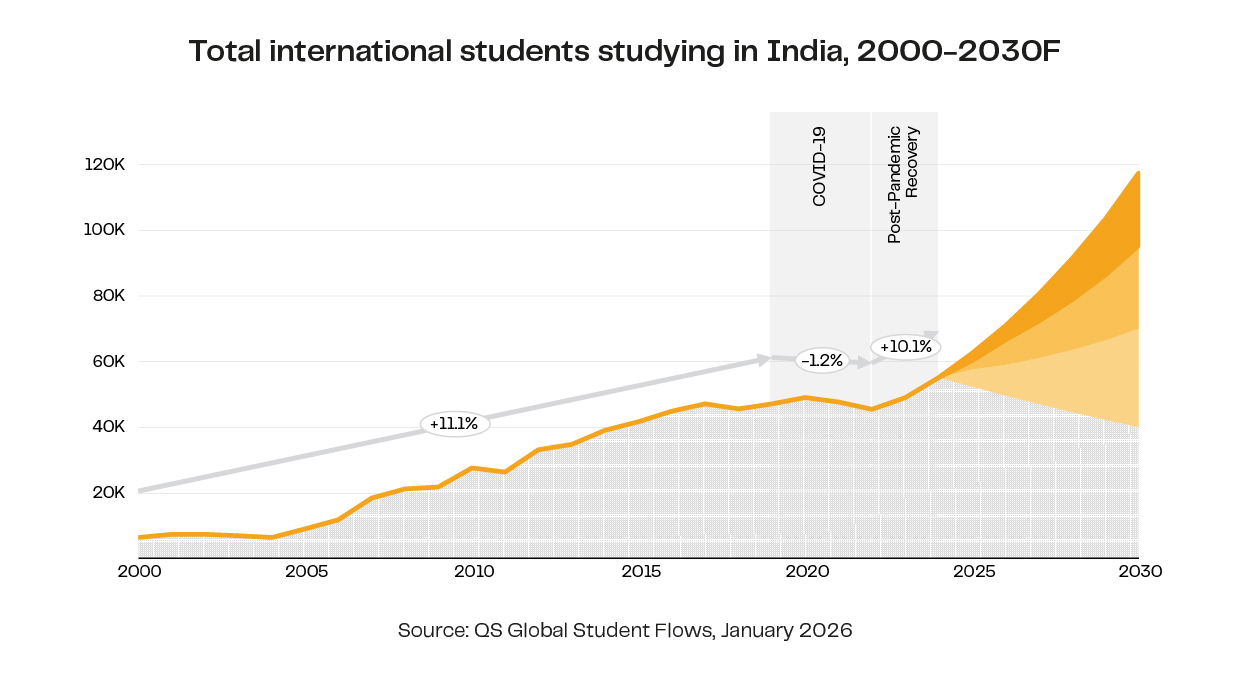
South Asia continues to anchor India’s international enrolments, accounting for nearly half of all foreign students. Nepal and Bangladesh alone contribute over 30%, with Nepal expected to expand at roughly 13% a year. Nepal and Bangladesh alone contribute more than 30%, with Nepal expected to expand at roughly 11% a year. Afghanistan, however, is slowing sharply. Visa approval rates have fallen, dampening growth to less than 1% annually and reducing its share from 10% to 9%. African demand, still modest in absolute terms, is shifting quickly. Zimbabwe stands out, with projected growth of around 11%, which would lift it from India’s 7th-largest source in 2024 to 6th by 2030. Demographic pressure, English usage, and rising awareness of Indian institutions across both East and West Africa are helping redirect mobility toward more affordable regional options.
Government reforms are reinforcing these developments. The long-term ambition of hosting 500,000 foreign students by 2047 is bold, but it signals intent rather than a prediction. Measures linked to the National Education Policy 2020 aim to open the door for respected foreign universities to establish local campuses and expand India’s transnational education landscape. New branch campuses, even when primarily oriented toward domestic students, help amplify India’s reputation as a more globally connected system. The University Grants Commission has further encouraged growth by allowing universities to reserve up to 25% additional supernumerary seats for international students. These seats increase capacity specifically for foreign students, though actual growth will depend on sustained demand. Visa processes are gradually becoming easier, strengthening India’s appeal at a moment when many Anglophone destinations are adding constraints of their own.
Structural constraints remain. Nepal continues to dominate India’s inbound flows, with students favouring cities like Bengaluru for cost, familiarity, and established networks. African interest is rising but remains small relative to India’s overall ambitions. Expanding into Muslim-majority markets may prove difficult, as the slowdown from Afghanistan illustrates. Domestic pressures, from intense competition for university places to a crowded graduate labour market, further limit how quickly India can scale foreign enrolments.
Even so, India enters the coming years with supportive policy frameworks and a shifting global backdrop that works in its favour. Regional demand is rising, administrative barriers are falling, supernumerary seats are expanding capacity, and perceptions are beginning to improve. If reforms hold and demand materialises, an annual increase of around 8% in inbound students looks achievable, even if the longer-term target will depend on how well India balances domestic pressures with global ambition.
Regulated Regionalism in India’s context describes a future in which the country becomes a central node in a more regionally distributed higher-education system, shaped by formal national policies rather than loose market forces. India tightens its governance of international education through clearer annual targets for foreign enrolments, linked to domestic capacity in areas such as campus infrastructure, housing supply, and labour-market priorities. Institutions seeking to host more international students are expected to show that they can provide adequate support and offer programmes aligned with the country’s skills agenda and NEP 2020. These controls allow India to expand its international footprint without overburdening urban systems already under strain.
As global demand for higher education keeps rising, mobility in this scenario becomes increasingly intra-regional. South Asia, West Asia, and Africa emerge as the fastest-growing corridors, and India becomes a natural destination for students from neighbouring countries looking for affordability, reputable institutions, and geographic proximity. At the same time, India invests heavily in its own educational infrastructure, accelerates the establishment of foreign university branch campuses, and expands dual-degree and twinning arrangements. Regional governments, including in the Gulf and Southeast Asia, also strengthen their higher-education ecosystems, but India’s scale and growing regulatory openness give it a notable advantage. These developments are supported by emerging regional credit-recognition systems and cross-border qualification frameworks that make it easier for students to combine study across multiple institutions.
This distributed model lowers the cost of international study for families across the region, shortens travel times, and allows students to access global credentials through Indian or India-linked providers. For India, it reduces pressure on metropolitan housing markets and helps concentrate incoming talent in sectors where it has explicit workforce goals, from engineering to health care.
Ultimately, regulated regionalism for India represents a more managed and evenly spread approach to international mobility, one that supports quality and relevance while anchoring student flows within the capacities and priorities of the national system.
Hybrid Multiversity in India’s context imagines a system in which international education is delivered through coordinated, multi-campus models that mix online, domestic, and overseas study. Indian students complete a large share of their degree at home or within the region, often through digital platforms or partner institutions, before undertaking shorter, purpose-built stints abroad. These overseas phases focus on activities that gain the most from physical presence: internships, laboratory work, clinical rotations, design workshops, language immersion, and industry networking. The model gives Indian families access to global exposure without the full cost of long-term study overseas.
Indian universities, together with partners in the Gulf, Southeast Asia, and Anglophone systems, develop shared credit-transfer rules, harmonised curricula, and aligned quality-assurance processes. This coordination allows students to shift between delivery sites with minimal friction. Faculties work across borders to synchronise learning outcomes and assessment cycles. The physical campus in India is repositioned as a specialised environment centred on facilities that cannot be replicated online, such as advanced engineering labs, simulation centres, and spaces for workplace-integrated learning.
Career preparation is built in from the outset. Micro-credentials earned during the India-based phase are embedded within academic records, giving employers earlier insight into skills. Many programmes include remote internships during the first years of study, followed by compulsory in-person placements during the global phase. Regulators support this design by easing short-term mobility pathways, refining visa processes, and formally recognising hybrid and online components for postgraduate work eligibility, both in India and in partner countries.
For India, the Hybrid Multiversity model offers a flexible and more affordable route to global education. It supports quality and relevance while matching student preferences, institutional capacity, and labour-market demands, ultimately positioning India as both a source and hub of digitally enabled, internationally connected higher education.
Talent Race Rebound in India’s context envisions a scenario in which the country positions itself as a premier hub for attracting global talent in response to domestic skills gaps and regional workforce pressures. By 2030, India must implement targeted policies to expand enrolments in high-demand fields such as artificial intelligence, cyber and quantum technologies, advanced manufacturing, biotechnology, healthcare, and renewable energy. Administrative bottlenecks that constrained international student intake in the late 2020s are replaced by streamlined, student-centred systems. Visas and study permits are processed rapidly, and extended post-study work opportunities are explicitly tied to structured, merit-based migration pathways, especially in STEM and priority sectors.
Universities deepen their alignment with government priorities and industry needs. National scholarship programmes focus on fields of strategic importance, while private-sector partners co-invest in internships, research projects, and employment pipelines for graduates. Research ecosystems benefit from multi-year grants, upgraded infrastructure, and recruitment of internationally recognised faculty, enhancing India’s attractiveness as both a study and research destination.
Infrastructure pressures, particularly on housing and campus capacity, are managed through coordinated investment, including public-private partnerships in tier-2 and tier-3 cities. This approach allows for higher enrolments while distributing students more evenly across regions, easing the strain on metropolitan centres.
For international students, India offers a compelling proposition: a full-degree, on-campus experience with access to quality academic programmes, professional networks, and credible pathways to employment and residency. Families increasingly regard study in India as a strategic investment in future opportunities. Demand rises sharply from neighbouring South Asian countries, the Gulf, Africa, and Southeast Asia, positioning India as a key player in the global competition for talent. International education in this scenario evolves from a tool of cultural engagement into a deliberate strategic lever for national development and human-capital leadership.
Outbound student flows from the MENA region to India are modest but steady, with enrolments projected to grow by around 4% annually over the next five years. As of 2024, students from the region made up roughly 18% of India’s foreign student body, with the UAE emerging as the largest source. Growth is driven by the search for high-quality yet affordable education, as well as the increasing availability of English-taught programmes and the expansion of international branch campuses across India. Historical ties between India and the UAE, alongside India’s prominence as a leading source of students for the Emirates, further reinforce these flows. By 2030, UAE students are expected to account for about 5% of India’s inbound student population.
Other countries in the region, including Yemen, Oman, and Iran, contribute smaller but stable numbers. For conflict-affected nations such as Yemen and Iraq, India offers a relatively safe and viable alternative. Yemeni students, for example, account for about 4% of India’s international students, and their numbers grew at an average of 4% between 2022 and 2025. Gulf students generally prefer cities such as Bengaluru, Pune, Hyderabad, and Chennai, drawn by established networks, quality education, and cultural familiarity.
Government initiatives play a central role in supporting MENA student mobility. The Study in India programme streamlines applications and visa processes, while scholarship schemes such as those offered by the Indian Council for Cultural Relations, extend financial support to students from Oman, Yemen, and Saudi Arabia. These targeted programmes, alongside the expanding range of English-taught courses, help mitigate cost and accessibility barriers, making India an increasingly viable option.
Overall, while flows from the MENA region remain relatively modest compared with South Asia or Africa, they are growing steadily. The combination of affordability, safety, scholarships, and English-language provision signals a gradual and strategic deepening of India’s educational ties with the Middle East, reinforcing its position as a regional study destination.
For students looking to study in India, institutional reputation is of increasing importance. When choosing a university, over 70% of candidates from the Middle East considering India as a study destination cite reputation as an important factor (Figure 14).
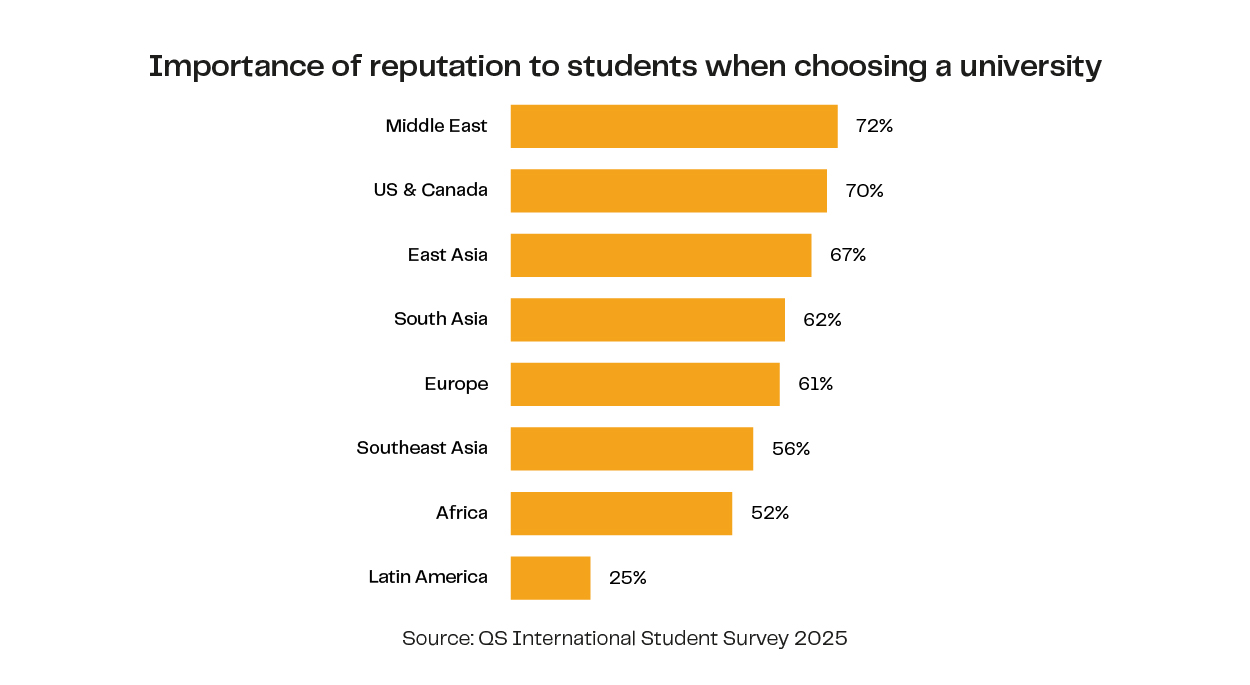
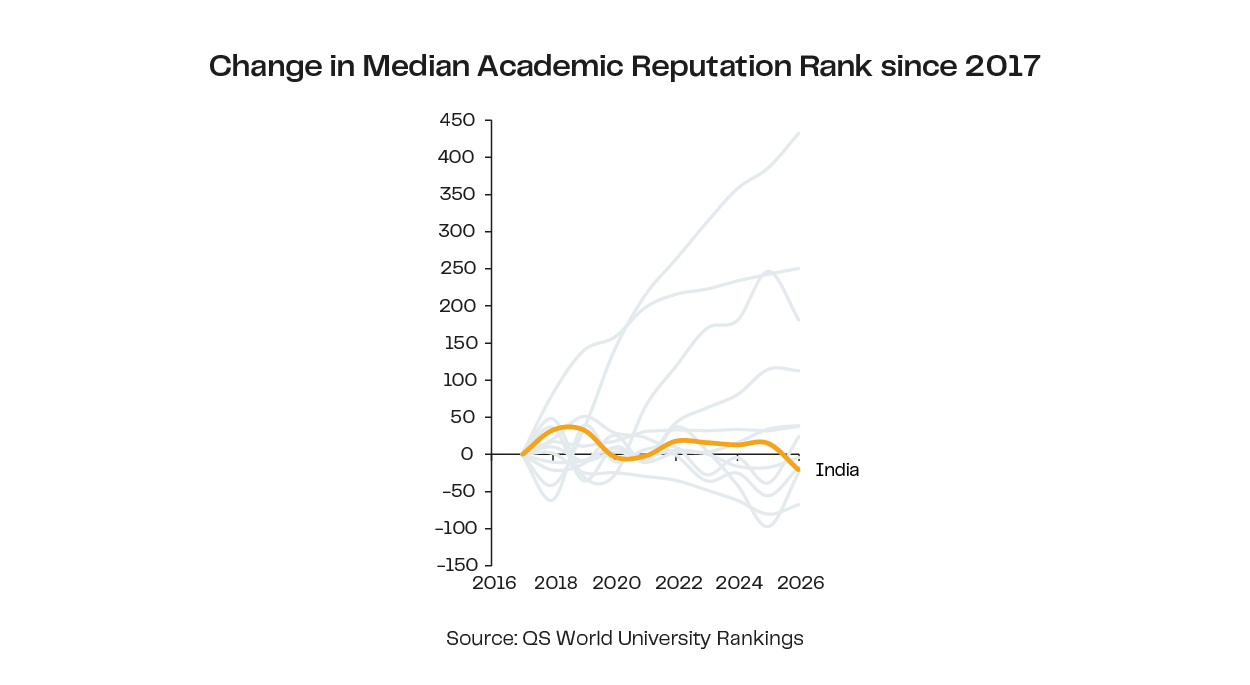
This trend reiterates the importance of Indian institutions raising their Academic Reputation, despite making little progress in recent years (Figure 15). For India to fully realise its potential and disrupt the dominance of the ‘Big Four’ study destinations will require institutions to enhance their global profile. The good news is that institutions have already begun to activate these strategies amongst graduate employers, where the reputation of Indian institutions has seen significant progress in recent years. The median Employer Reputation rank of Indian institutions has improved by 61 places since 2017 (Figure 16).
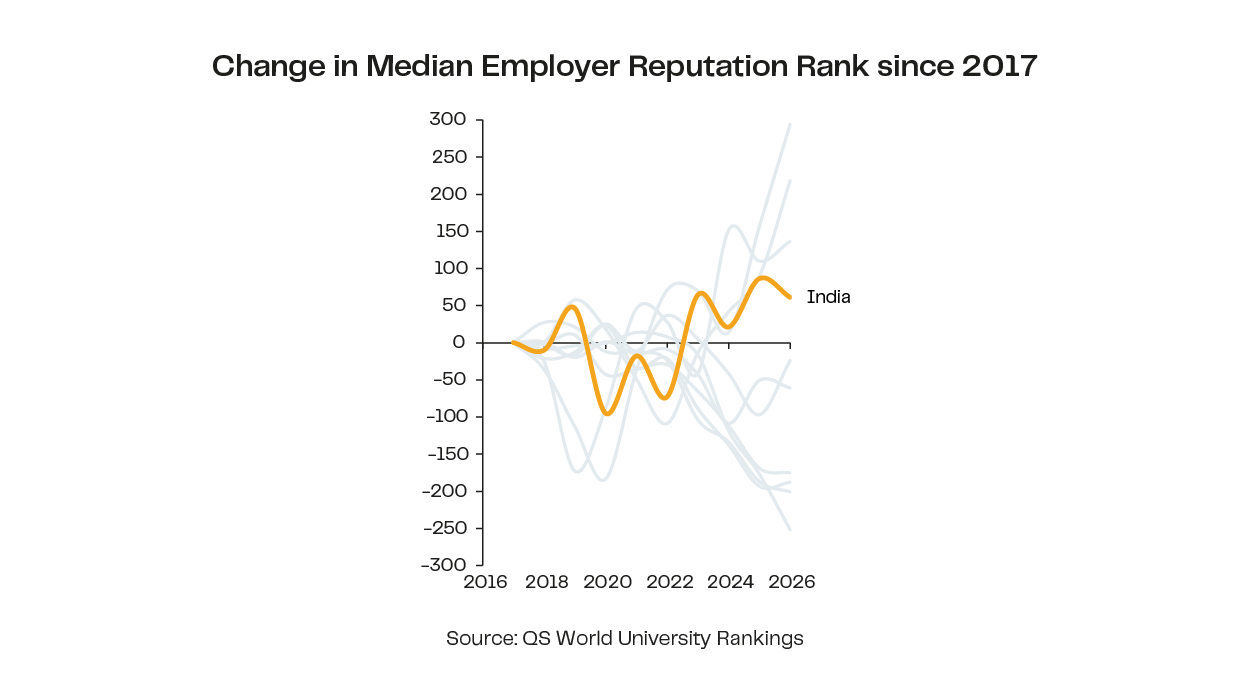
The rising reputation of Indian institutions amongst graduate employers bodes well for students, who are increasingly focused on post-study employment outcomes when making study decisions. When asked about their marketing communication preferences, 50% of students cited information on work placements and links to industry as something they would want to hear about from universities, the second highest rated answer to that question. Students from Southeast Asia are the most likely audience to cite this as an important factor.
This reiterates the need for Indian institutions to embed graduate employability into their strategic planning and ensure students are equipped with the skills needed by employers. According to a 2025 report from Mercer-Mettl, only 42.6% of Indian graduates are employable. In India, institutions employment outcomes are on average significantly worse than the reputation of those institutions amongst employers would suggest (Figure 17). This disparity suggests that whilst institutions have made significant progress in raising their reputation, this hasn’t yet let to material improvements for the graduate experience.
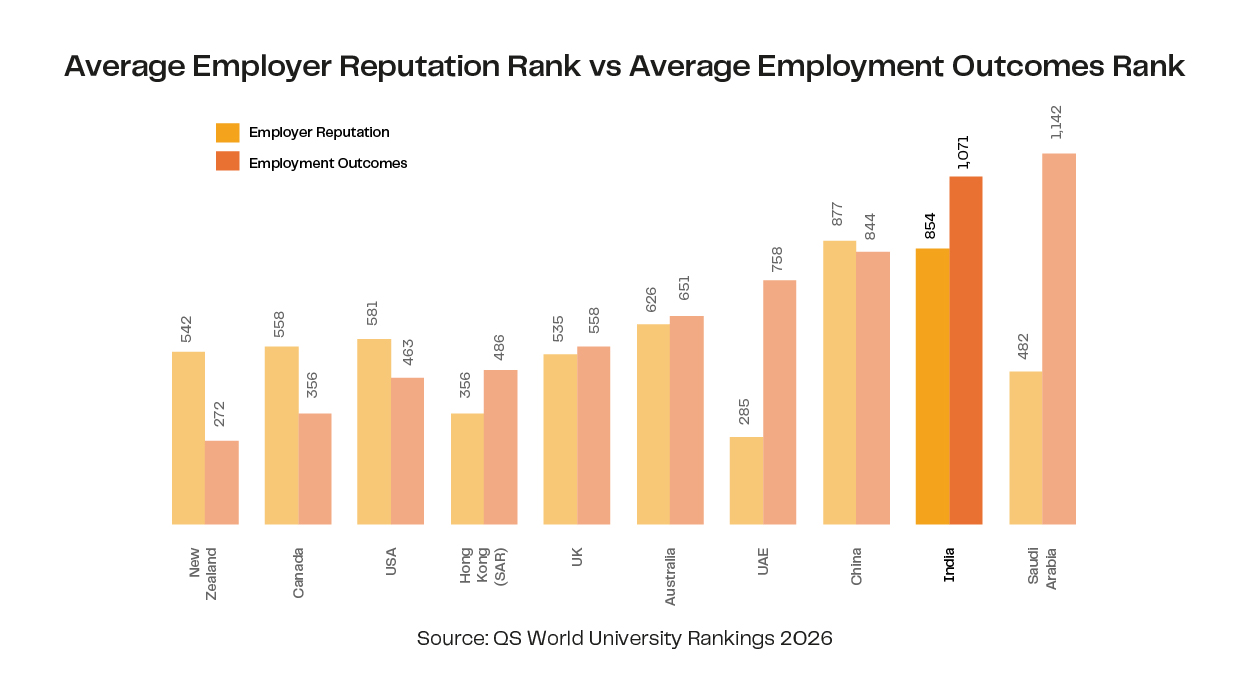
To create parity, institutions need to make graduate skills development a core component of existing and upcoming curricula creation. Ensuring that graduates have the appropriate mix of skills to meet the existing and future demands of local employers should be central to this strategy. In doing so, institutions can transform their capacity to become drivers of economic growth and enhance their reputation among employers.