.jpeg)


QS World Future Skills Index 2027 - Canada Briefing



24 July 2026


Download the full briefing for the complete analysis. Read a few key findings below.
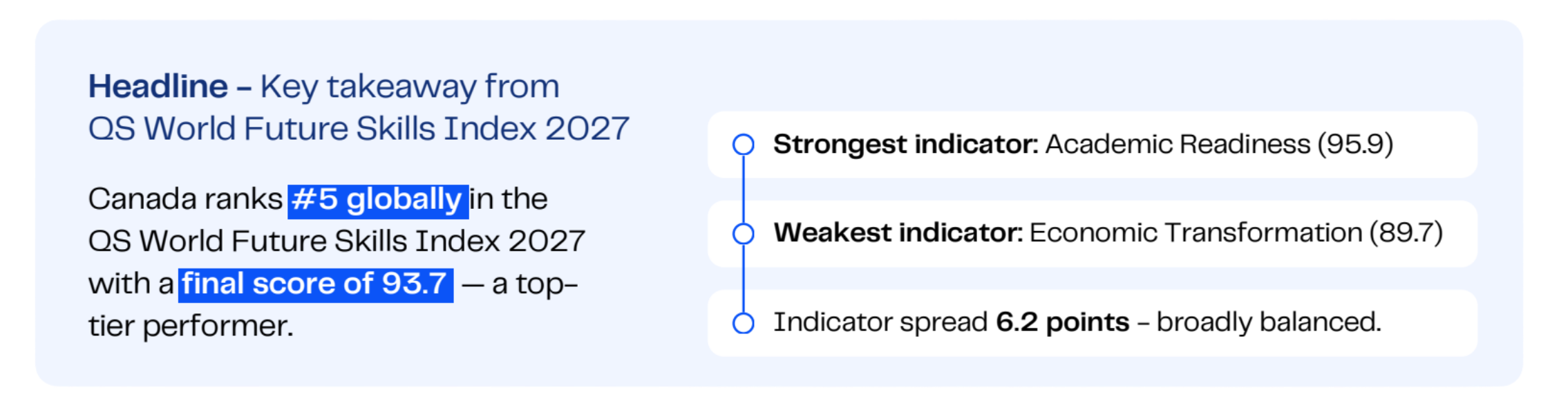
The Canada profile shows a highly balanced performance across the four indicators (spread of 6.2 points). Its strongest contribution comes from Academic Readiness (95.9, rank #7), while Economic Transformation is the relative weak spot (89.7, rank #21).
The indicator profile suggests the economy has built strong human-capital and academic foundations, but underlying economic conditions may constrain its ability to fully translate those foundations into realised workforce transformation.
Peer positioning insight - comparison against regional and income-group cohorts
In its regional cohort (North America), Canada ranks #2 of 2 eligible economies. Its Final Score of 93.7 compares to a regional median of 96.4 (-2.8 vs regional median).
In its income-group cohort (High-income countries), it ranks #5 of 47 eligible economies, with its Final Score +15.0 vs the income group median of 78.7.
The closest regional rival is United States; the closest income-group rival is South Korea.
closest 5 by Final Score within selected economy's region
closest 5 by Final Score within selected economy's income group
The QS World Future Skills Index evaluates how effectively economies can develop, align, and apply skills in a fast-changing global economy. Rather than focusing on higher education only or labour markets in isolation, the Index measures how well higher education systems align with workforce needs in the age of AI.
As economies around the world adapt to the transformative impact of AI, both labour markets and higher education institutions face growing pressure to evolve. Covering 89economies, the Index assesses readiness to harness the opportunities created by AI through a talent-supply and talent-demand analysis. It combines QS’s proprietary data on university performance, jobs and skills, and AI transformation with internationally recognised indicators to provide a global benchmark of AI readiness.
Canada ranks fifth globally in the QS World Future Skills Index 2027 with a Final Score of 93.7. The country’s supply side (Academic Readiness, Skills Alignment) is stronger than its demand side; Canada’s lower Economic Transformation score reflects low R&D intensity, an aging workforce, and 2025 trade headwinds.
Canada combines exceptionally high tertiary attainment (G7-leading) with an internationally-anchored, provincially-fragmented system and a labor market currently absorbing two simultaneous shocks: deliberate constraint of international student flows and AI-driven compression of entry-level white-collar hiring. The 2024-25 international student cap is the most consequential policy intervention in a generation and has materially altered the financial model of the post-secondary sector, particularly in Ontario and British Columbia. However, Canada maintains institutional excellence: 3 universities in the QS World University Rankings 2026 top 50, with the University of Toronto (#25) consistently among the global top 30, and strong performance across earth sciences, life sciences, and sustainability-related subject rankings. The first-ever inversion of Canada's degree premium for young workers (LMIC-Conference Board, 2025) is a structural early warning that the system is producing more bachelor-level graduates than the AI-disrupted entry-level economy currently absorbs, though long-term degree ROI remains positive.