
.jpeg)


The strategic role of higher education to deliver the Government's Industrial Strategy

.png)
.png)

3 February 2026


In this report, created in partnership with the University of York and Public First, QS Quacquarelli Symonds examines how higher education will need to evolve if the UK is to deliver its Industrial Strategy and realise the economic potential of artificial intelligence.
Drawing on QS Labour Market Intelligence, we map nearly 1,900 occupations across the UK economy and identify more than 1,400 roles that are critical to the government’s eight priority growth sectors. Our analysis shows that around 80% of these roles require degree-level qualifications, highlighting the central role of universities in building the skills pipeline needed for long-term growth.
We estimate that AI could add up to £490 billion to the UK economy by 2030. However, the report finds that these gains will depend less on automation than on how effectively AI is used to augment jobs, placing graduate skills, lifelong learning and workforce reskilling at the centre of future productivity gains.
This report is intended for policymakers, higher education leaders and employers seeking evidence on how skills, education and industrial policy must align in an AI-enabled economy.
Read an excerpt below, and download the full report.
The UK's ambition for economic growth through to 2030, particularly in the eight high-growth sectors of the modern Industrial Strategy (IS-8), is critically dependent not only on advanced technology innovation, but on strategic planned investment in human capital.
This new research projects that a concerted focus on expanding graduate skills in the key growth industries of the future, and the effective integration of Artificial Intelligence (Al) could triple annual GDP growth, unlocking a cumulative £490 billion for the UK economy by the end of the decade. This projected economic uplift is overwhelmingly driven by Al-augmented roles rather than automation, making the supply of a skilled - and in particular graduate skilled - workforce the decisive necessary condition to achieve the ambitions of the National Industrial Strategy.
The analysis frames the UK's potential growth on three layers: baseline organic growth, targeted expansion of Strategic Industries, and a decisive layer of Al-driven productivity. Al alone is forecast to contribute around 2.8% of additional GDP growth, equivalent to the £490 billion premium. However, a severe skills shortage threatens to become the binding limit on this growth. Our study finds that 80% of the over 1,400 occupations deemed critical to the Industrial Strategy 8 (IS 8) sectors require degree-level qualifications (Level 6 or above). Furthermore, the existence of over 630 high-importance 'transectoral' occupations - critical to two or more growth sectors - means a shortage in these roles could create immediate simultaneous bottlenecks across multiple high-growth industries.
To realise this economic opportunity, the UK's higher education sector has a crucial and unique role. The data confirms the importance of Level 6 qualifications for the vast majority - over 80% - of critical IS-8 occupations. Investment in human capital - and by extension higher education - is what will translate technological potential into economic output.
The findings highlight a critical inflection point for the UK - we must urgently recognise that the nation's economic ambitions hinge on a comprehensive skills pipeline, demanding a new era of integrated system-level partnership. But without urgent and sustained investment in higher education to deliver the necessary augmented skills, the UK risks missing its largest productivity opportunity in a generation and falling behind global competitors.
Government, employers, and higher education leaders must align their strategies to address critical future skills gaps. Policymakers must recognise the flexibility and critical nature of 'transectoral' occupations and support universities actively to achieve the financial resilience to be able to provide the necessary training. Without this alignment and collaborative approach, the UK cannot effectively harness the collective power of technology, education, and industrial collaboration, forfeiting the opportunity for economic renewal and exploiting the potential to build global dominance in key sectors necessary to tackle major social and environmental challenges.
We forecast a total of 1436 ‘fundamental’ occupations which are of high/very high importance in just one IS-8 sector, but are critical to the delivery of these IS-8 sectors.
There is a big overlap of key 'Transectoral' occupations. These are occupations which are critical to the growth of more than one IS sector. A total of 635 of these 'transectoral' occupations are of 'high' or 'very high' importance to two or more IS-8 sectors. These are, from the perspective of policymakers and national and local politicians, the closest thing to a no-lose bet for growth in their supply. A shortage of these roles will mean that multiple sectors are hampered in a push for growth. Perhaps as importantly, if policymakers and educational institutions don't recognise the flexibility of these occupations, there is a risk of undersupply - because, for example, the UK economy doesn't just need Al skills for one sector, but for multiple sectors.
We reconfirm analysis that shows the importance of high level skills to these crucial occupations, especially within the IS-8. At present, over 80% of occupations within the QS taxonomy deemed as high importance to at least one IS sector require a Level 6 qualification.
If UK Higher Education equips graduates with the necessary Al and other emerging skills required by the labour market, job augmentation is going to be 50% greater than job automation in the UK. Just within the IS-8, this could represent hundreds of thousands of new jobs. We forecast an Al Augmentation premium of £490bn in UK GDP by 2030. This forecast reflects a layered growth model in which modest organic growth and targeted expansion of UK Strategic Industries are materially accelerated by Al-driven productivity gains. The uplift is driven by higher output per augmented worker and the expansion of Al-augmented roles, made possible by the quality and adaptability of the UK's human capital.
We recognise a crucial role for universities in delivering the skills needed for the Industrial Strategy to succeed. Government has set a clear vision for a greater share of adults to be trained to a tertiary level. Universities need to work alongside Mayoral authorities, employers, and national government to identify their skills needs and provide the training necessary. Yet at the same time, the sector and government will need to acknowledge and manage the counter pressures in the current system which lead to undersupply of some key courses, and the relationship between domestic demand (including that driven by demographics in the near future) and international student flow.
This proprietorial QS taxonomy maps the entire UK labour market across broad industry categories.
It shows a composition across six broad themes, 12 major industry groupings, then 59 sectors and 94 sub sectors that sit within them, and - most pertinently - every single role in the UK labour market categorised into one of 1,890 occupations.
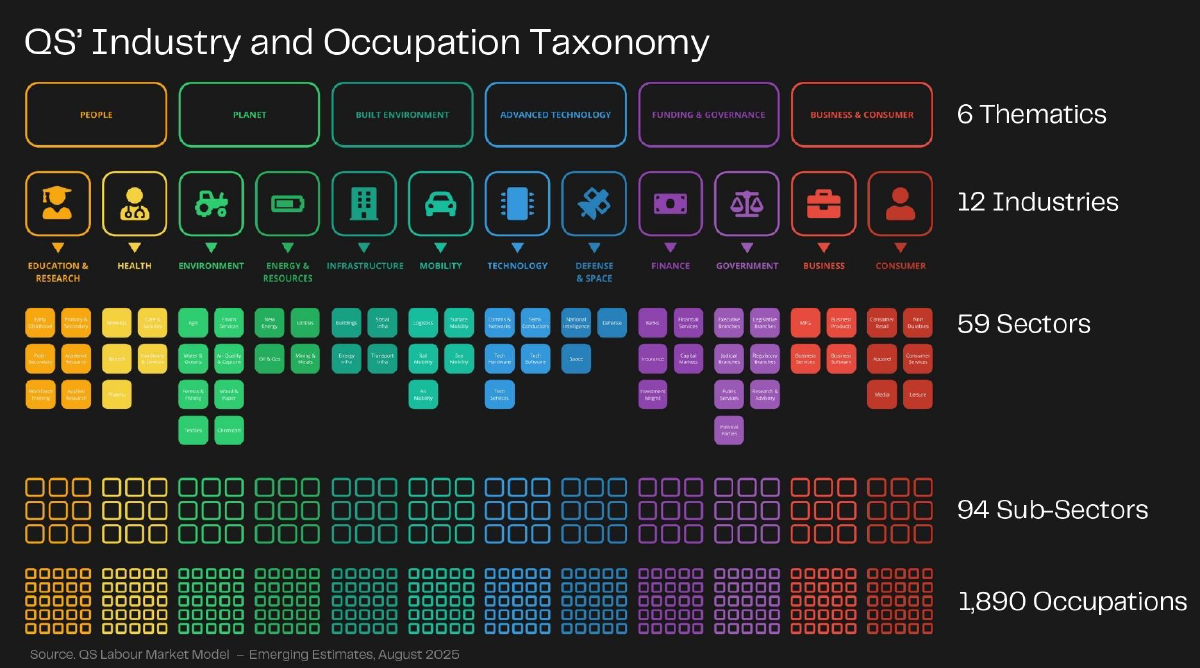
Using the QS taxonomy, we can map the entire UK labour market. The charts here show how the 1,890 specific occupations for the current UK labour market divide between the broad 12 industrial groups, and the number of workers in such roles currently.

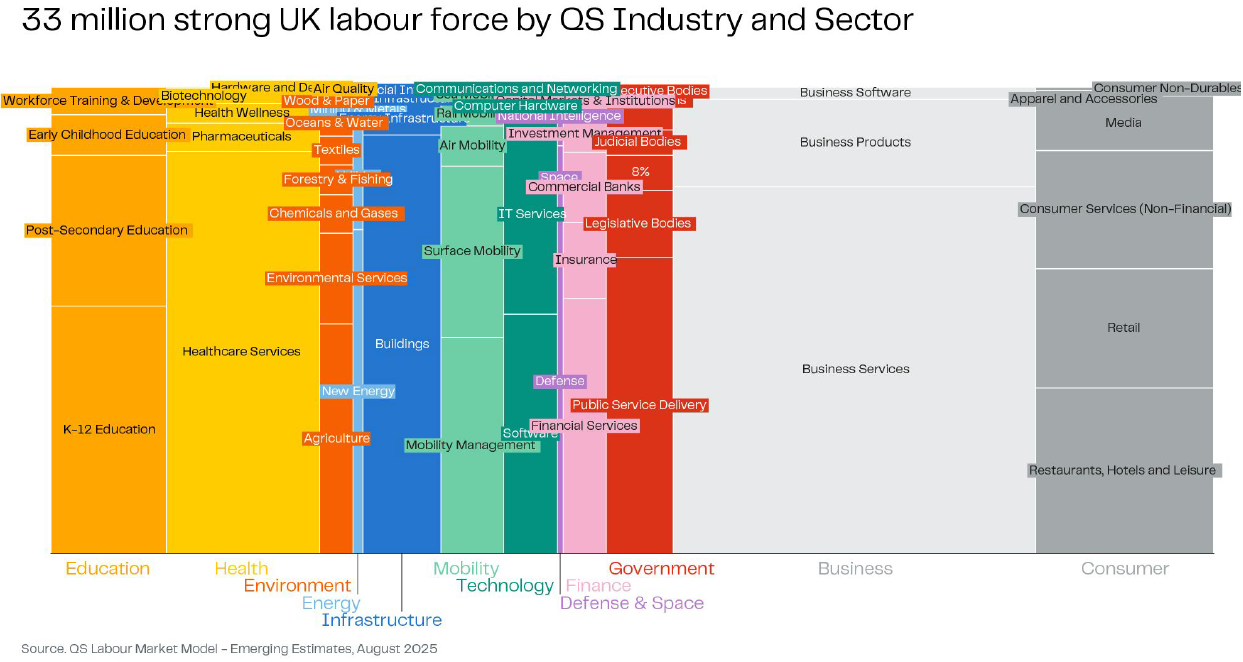
This is an alternative way to look at the same data. Here, each of the 12 industrial groups is shown in colour as a share of the total UK labour market, and the vertical decomposition shows the 59 sectors that make up the economy.



.png)