.jpeg)


QS World Future Skills Index 2027 - Australia Briefing



3 August 2026


Download the full briefing for the complete analysis. Read a few key findings below.
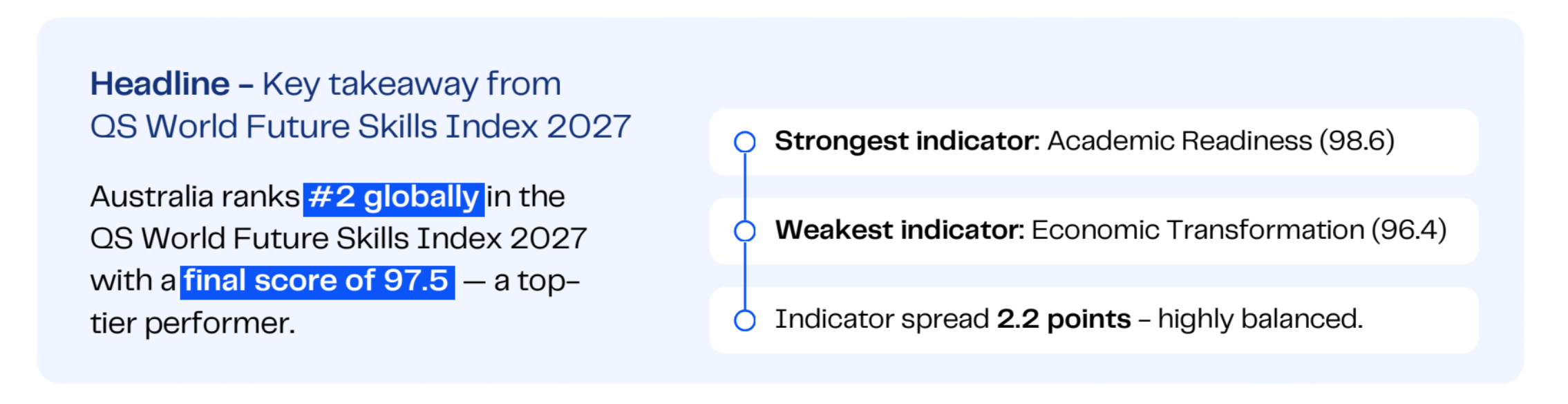
The Australia profile shows a highly balanced performance across the four indicators (spread of 2.2 points). Its strongest contribution comes from Academic Readiness (98.6, rank #3), while Economic Transformation is the relative weak spot (96.4, rank #8).
The profile suggests the economy has built strong human-capital and academic foundations, but underlying economic conditions may constrain its ability to fully translate those foundations into realised workforce transformation.
Peer positioning insight - comparison against regional and income-group cohorts
In its regional cohort (East Asia & Pacific), Australia ranks #1 of 14 eligible economies. Its Final Score of 97.5 compares to a regional median of 81.2 (+16.2 vs regional median).
In its income-group cohort (High-income countries), it ranks #2 of 47 eligible economies, with its Final Score +18.8 vs the income group median of 78.7.
The closest regional rival is South Korea; the closest income-group rival is United Kingdom.
closest 5 by Final Score within selected economy's region
closest 5 by Final Score within selected economy's income group
The QS World Future Skills Index evaluates how effectively economies can develop, align, and apply skills in a fast-changing global economy. Rather than focusing on higher education only or labour markets in isolation, the Index measures how well higher education systems align with workforce needs in the age of AI.
As economies around the world adapt to the transformative impact of AI, both labour markets and higher education institutions face growing pressure to evolve. Covering 89economies, the Index assesses readiness to harness the opportunities created by AI through a talent-supply and talent-demand analysis. It combines QS’s proprietary data on university performance, jobs and skills, and AI transformation with internationally recognised indicators to provide a global benchmark of AI readiness.
Australia ranks #2 in the Index, underpinned by world-class higher education, a services-led labour market, and nine QS World University Rankings top 100 universities. The country demonstrates particular strength in Skills Alignment, Academic Readiness, and Future of Work, supported by globally recognised capabilities in mining, earth sciences, agriculture, and sustainability. Recent reforms, including the establishment of the Australian Tertiary Education Commission (ATEC) — the most significant sector overhaul in two decades — aim to better align domestic workforce needs with continued international growth.
However, persistent challenges remain, including dependence on international student funding, relatively low R&D investment, and ongoing skills shortages across healthcare, trades, and regional occupations. Overall, Australia has built strong human-capital and academic foundations, though broader economic constraints may limit the pace at which these strengths translate into workforce transformation.