.jpeg)

QS World Future Skills Index 2027 - South Korea Briefing


12 August 2026


Download the full briefing for the complete analysis. Read a few key findings below.
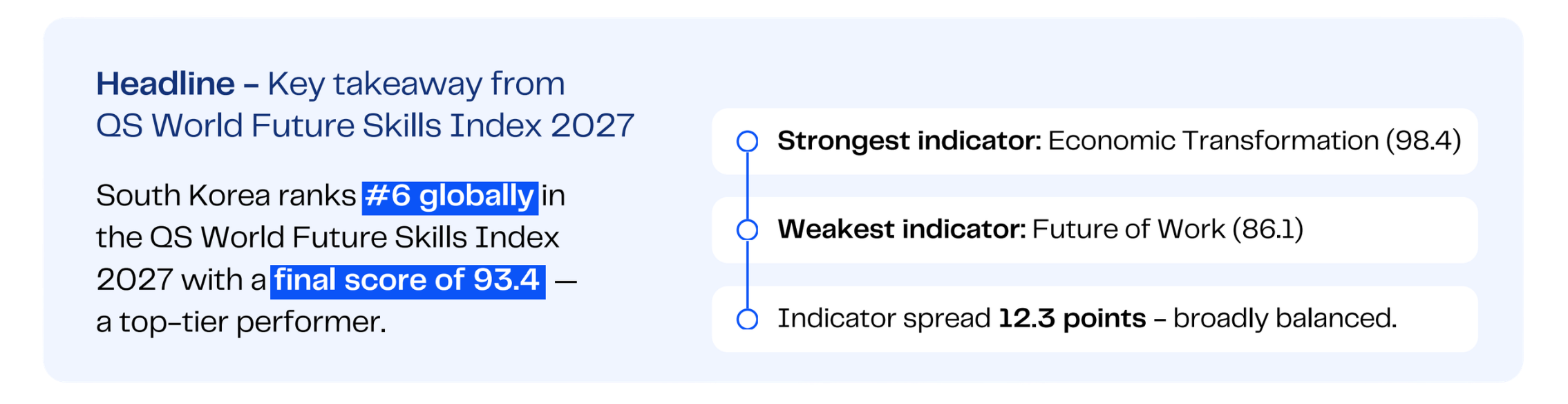
The South Korea profile shows a highly balanced performance across the four indicators (spread of 12.3 points). Its strongest contribution comes from Economic Transformation (98.4, rank #4), while Future of Work is the relative weak spot (86.1, rank #15).
Economic conditions appear supportive, but skills and academic foundations need strengthening to convert that economic capacity into future-ready workforce outcomes.
Peer positioning insight - comparison against regional and income-group cohorts
In its regional cohort (East Asia & Pacific), South Korea ranks #2 of 14 eligible economies. Its Final Score of 93.4 compares to a regional median of 81.2 (+12.2 vs regional median).
In its income-group cohort (High-income countries), it ranks #6 of 47 eligible economies, with its Final Score +14.7 vs the income group median of 78.7.
The closest regional rival is China; the closest income-group rival is Canada.
closest 5 by Final Score within selected economy's region
closest 5 by Final Score within selected economy's income group
The QS World Future Skills Index evaluates how effectively economies can develop, align, and apply skills in a fast-changing global economy. Rather than focusing on higher education only or labour markets in isolation, the Index measures how well higher education systems align with workforce needs in the age of AI.
As economies around the world adapt to the transformative impact of AI, both labour markets and higher education institutions face growing pressure to evolve. Covering 89economies, the Index assesses readiness to harness the opportunities created by AI through a talent-supply and talent-demand analysis. It combines QS’s proprietary data on university performance, jobs and skills, and AI transformation with internationally recognised indicators to provide a global benchmark of AI readiness.
South Korea presents the QS World Future Skills Index 2027’s sharpest paradox. Placing sixth overall, (Final Score 93.4) with world-leading Skills Alignment (95.9, rank five) and Economic Transformation (98.4, rank four) but lower Future of Work positioning (86.1, rank 15) and graduate-skill mismatches, as reported by employers (-23.2 in cognitive skills gaps, the worst of any top 10 economy).
The structural reading is that Korea's deep human capital, STEM-rich pipeline and corporate R&D intensity are colliding with three binding constraints: demographic collapse hollowing out the regional university sector and the labour supply; a rigid dual labour market that traps graduates between prestigious chaebol jobs and precarious non-regular work, manifesting in rising graduate underemployment pressures; and cultural intensity around credentialism that the Glocal/RISE reforms and the digital-talent agenda are explicitly trying to disrupt by redistributing prestige and funding away from Seoul.
Korea exemplifies an economy where Academic Readiness alone cannot guarantee skills demand absorption. The binding indicator is now Future of Work alignment and graduate employability, not university quality. The impetus to re-skill workers mapped to key future growth skills and occupational categories will be critical to benefit from the potential of AI and must come as part of a combined effort from industry, higher education and government.