



What's changed for international students in Australia – and what hasn't?

6 November 2026


Australia's international higher education sector has experienced significant change in recent years, including visa fees, tighter immigration policies, and growing competition between study destinations.
Despite these shifts, students' fundamental priorities remain relatively consistent, with insights from Student Mobility and Motivation: Australia revealing that affordability, a welcoming environment and future opportunities continue to shape destination choices.
The question for Australian universities is how to respond to these changing conditions by focusing on what they can control: clear communication, consistent information and supporting students throughout their decision-making journey.
Australia's international education landscape has undergone significant policy and economic changes since 2019, affecting both student recruitment and institutional planning. Rising visa fees, changes to post-study work arrangements and tighter visa requirements have introduced additional financial pressures and uncertainty for prospective students.
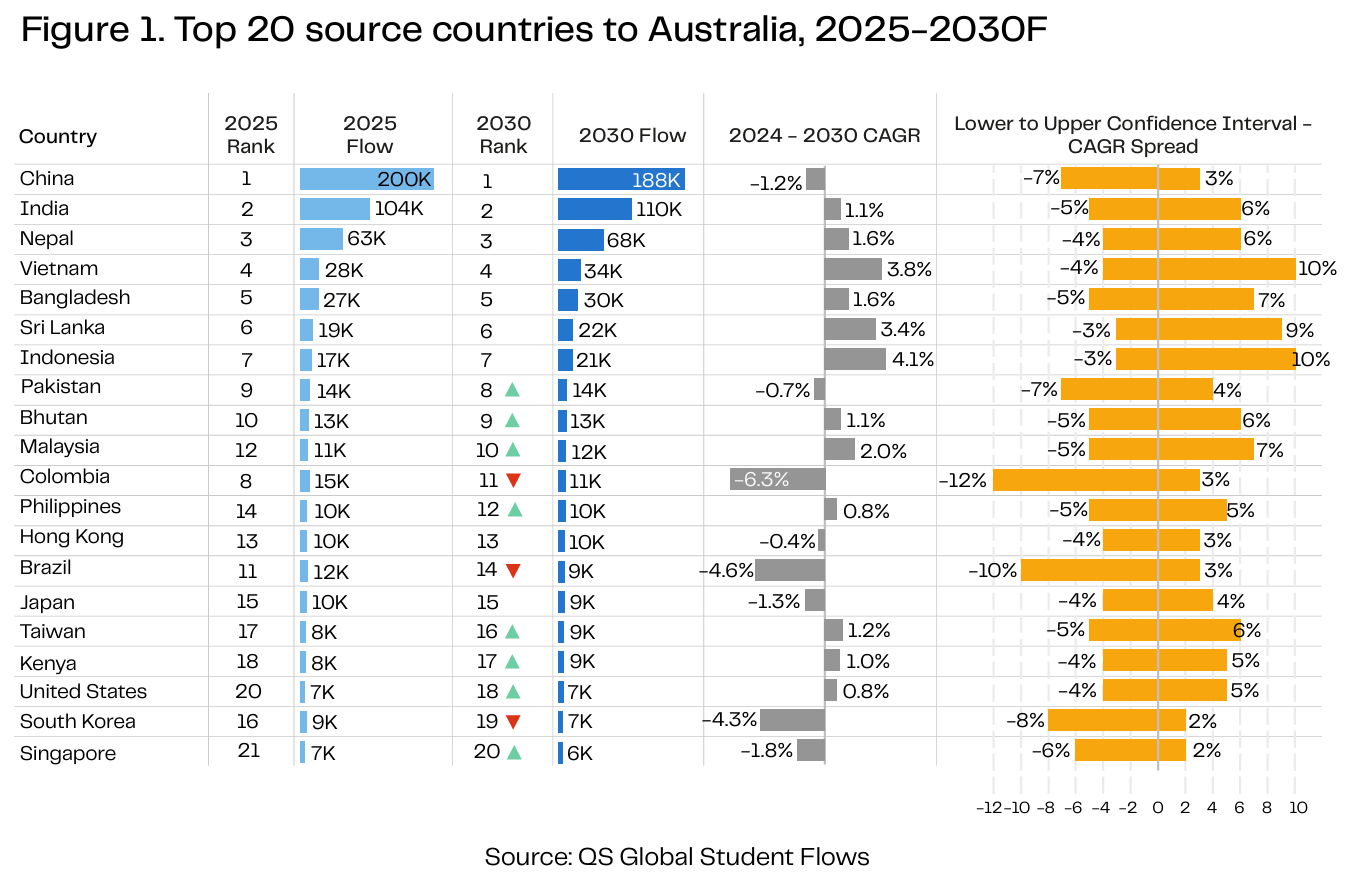
QS Global Student Flows forecasts now project approximately 678,000 inbound international students by 2030, down from an earlier projection of 738,000 – a reduction of 8.1%.
However, opportunities for growth remain across individual source markets. Between 2025 and 2030, inbound student numbers from Vietnam are forecast to increase by approximately 5,800, Indonesia by 3,800 and Sri Lanka by 3,400. Meanwhile, numbers from China are projected to decline by 11,400 over the same period.
Despite these developments, students' fundamental expectations of their study destination remain familiar.
Comparing findings from the 2019 and 2026 QS International Student Surveys reveals three consistent priorities:
In 2026, 59% of Australia-bound prospective students identified a welcoming environment as an important factor when choosing a country. Affordable living costs and affordable study costs were selected by 40% and 39% respectively.
Scholarships and post-study work opportunities have also become more prominent, reflecting the growing importance of financial support and future employment prospects.
The findings suggest that while students are navigating different circumstances, their underlying expectations remain largely consistent. The challenge is therefore not necessarily to change their entire recruitment proposition, but to communicate its value more effectively within today's environment.
Australia continues to hold a strong position in prospective international students' perceptions. According to the International Student Survey (ISS) 2026, 69% associate Australia with a good quality of life, while 54% describe it as environmentally friendly and 53% recognise its work opportunities.
However, only 18% perceive Australia as affordable, despite cost remaining a major consideration when choosing where to study.
This concern extends beyond prospective students. Research involving current international students, including QS's work with Austrade and Study Australia Partners and Allianz's State of Student Health report, highlights a significant gap between financial expectations and the reality of studying in Australia.
This disconnect can contribute to dissatisfaction with the overall student experience, with research indicating that approximately one in four international students seriously consider withdrawing from their study programme.
For universities, these findings highlight the importance of setting realistic expectations before enrolment. Clear information about tuition fees, accommodation, living expenses, scholarships and available support can help students better understand the financial commitment involved.
Communicating return on investment is equally important. Highlighting alumni career pathways and graduate employment outcomes can help prospective students assess the long-term value of their education.
As students navigate changing policies and financial requirements, access to reliable information becomes increasingly important. The ISS 2026 reveals that prospective students consult several sources when researching their options.
Official university websites remain the most influential, selected by 75% of Australia-bound students, followed by general online search (57%), social media (47%) and university rankings (37%). Education agents and consultants are also important, selected by 32%.
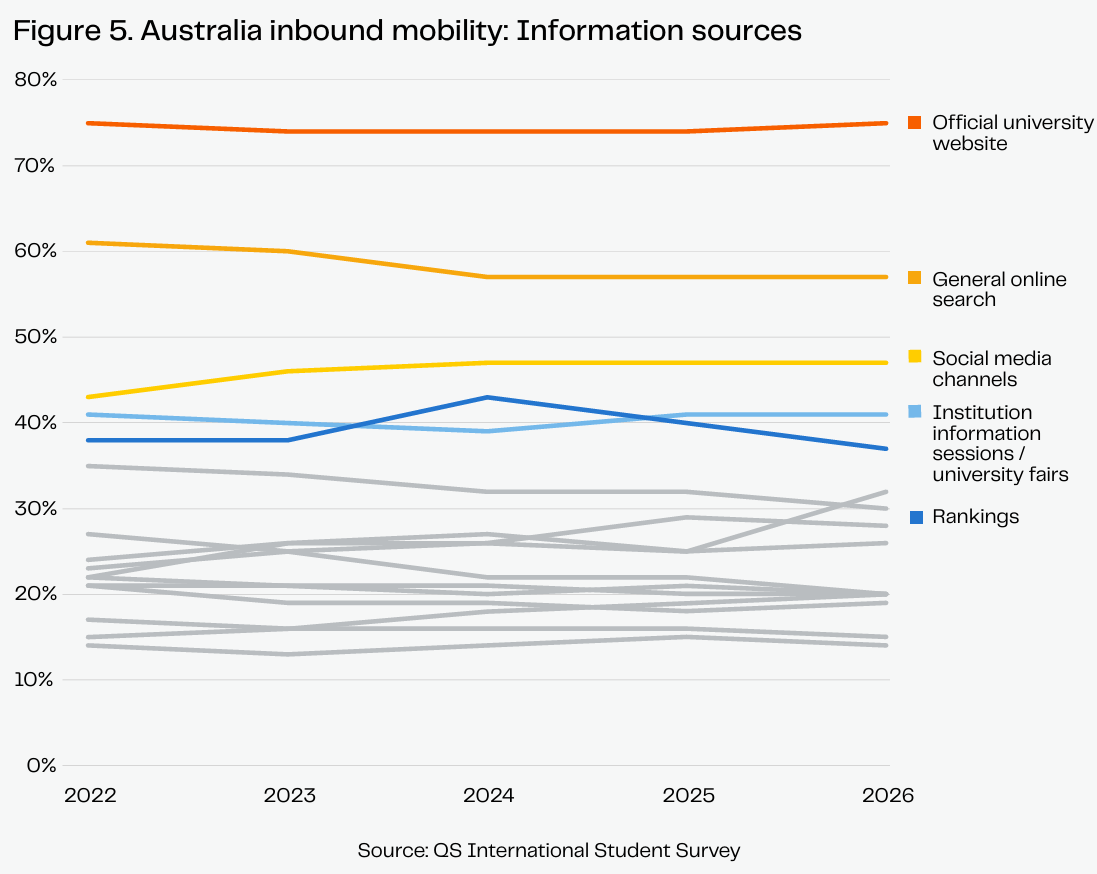
This presents a challenge for institutions: students may receive information from several channels before making an application. If university websites, agents, admissions teams and social media communicate different information about fees, eligibility or visa requirements, students may struggle to make confident decisions, so therefore, maintaining consistency across these touchpoints is essential.
Responsiveness also matters, as the ISS 2026 found that expectations for receiving an application outcome within 24 hours have increased by eight percentage points since 2022. Timely communication can help maintain student confidence throughout the recruitment journey.
While universities cannot control national immigration policies or wider economic conditions, they can influence how effectively students understand and navigate their options.
Australia's international education sector will continue to face changing policies, market conditions and recruitment pressures, but insights suggest that students' fundamental priorities have remained relatively stable, as they continue to seek welcoming destinations, affordable study opportunities and clear pathways towards their future.
For Australian higher education institutions, the opportunity lies in focusing on what they can control. Providing reliable information, maintaining consistent communication and helping prospective students make informed decisions with confidence will be crucial in a more competitive market.