
.jpeg)


Latin America’s future skills race: Where demand is outpacing education readiness

3 July 2026


Latin America’s performance in the QS World Future Skills Index 2027 shows clear regional disparity. Some economies have the higher education strength and skills supply to compete globally, while others show stronger signs of future labour-market demand than their education systems are currently ready to supply. The priority across LATAM will be closing the gap between the skills economies are beginning to need, and building talent systems that are equipped to deliver.
Compared to other regions around the world, LATAM is a middling performer that consistently outperforms MENA, South Asia and Sub-Saharan Africa, but fails to reach the consistent heights of Europe, APAC and North America.
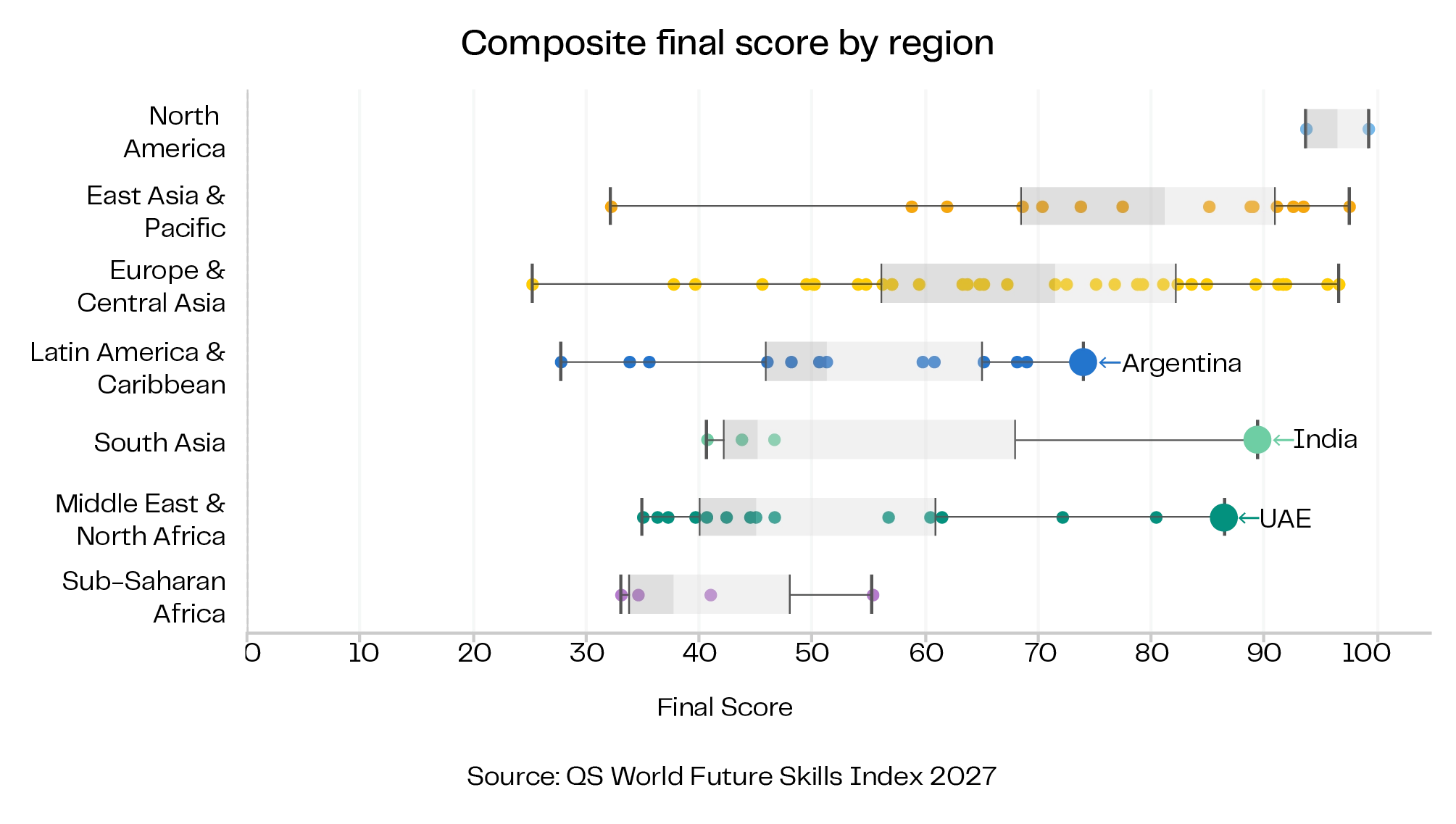
Argentina is the region’s top performer, ranking #31 globally with a score of 74.0. Its advantage is demand-led, with Argentina scoring 83.2 in Future of Work and 80.0 in Economic Transformation. Argentina’s lowest score is in Skills Alignment, meaning employers report dissatisfaction with graduate skills. The country is therefore well placed to benefit from future-work momentum, but only if institutions and employers can work more closely to translate economic potential into job-ready graduate capability.
While Argentina’s supply and demand is unbalanced, elsewhere in Latin America that gap is even more stark. Panama’s demand-side indicator average is 66.3, compared with a supply-side average of just 25.6, a 40.6-point gap. That makes Panama the clearest regional example of economic and workforce transformation potential running ahead of skills and academic readiness. Without faster investment in skills development and education capacity, Panama’s economy will not have the volume of talent required to meet workforce demands.
Peru tells a similar story. Ranking #41 overall, Peru combines a high Future of Work score of 81.2 with a much lower supply-side average of 55.3. Demand for skills is forming faster than the talent pipeline can adapt. That creates an opportunity for universities to position themselves more directly around employability, reskilling and industry collaboration, particularly in sectors where new forms of work are emerging quickly.
Brazil has a different challenge, combining strong Academic Readiness (78.2) and Economic Transformation (82.5) with a much weaker Skills Alignment score (43.3). Brazil’s issue is therefore less about institutional scale and more about whether graduates are leaving education with the skills employers need. For a large higher education system, the next phase of competitiveness may depend less on expanding provision and more on making curricula, employer engagement and graduate outcomes work harder together.
Chile's supply-side average (77.2) is well ahead of its demand-side average (60.7), suggesting a comparatively strong education and skills base, but weaker current labour-market transformation signals. This could lead to brain drain, with high-quality talent seeking more innovative labour markets. The priority for Chile is therefore not simply producing skilled graduates, but creating stronger domestic pathways for them to apply those skills in emerging industries.
Ranked #50, Mexico has a stronger supply-side average (64.1) than demand-side average (55.3). Its Future of Work score (44.6) is the main drag, meaning that Mexico’s challenge is less about education capacity and more about the prominence of AI, digital and green jobs in the labour market, and how likely Mexico’s workforce is to be augmented by AI. The risk is that existing education strength does not fully translate into future-work advantage unless demand for these roles grows more quickly.
Overall, Latin America’s story is not one of uniform underperformance. Argentina leads, Panama and Peru show demand racing ahead of supply, Brazil needs stronger skills alignment, Chile has supply-side strength waiting for more demand, and Mexico needs to convert education capacity into future-work momentum. For future success, alignment across skills supply and demand will result in a more prepared economy. The institutions and systems that move fastest will be better placed to support national competitiveness, graduate employability and long-term economic resilience.