
.jpeg)


Is Yorkshire and the Humber producing enough graduates to meet future skills demand?
.png)
15 October 2026


Yorkshire and the Humber has significant ambitions for economic growth, particularly in advanced manufacturing, clean energy, life sciences and digital technologies, but research suggests that shortages of skilled graduates could make these ambitions harder to achieve.
The QS report Supercharging Yorkshire & Humber: Unlocking £38 Billion in Growth Through AI, Skills and Systems-Scale Integrated Planning, developed in partnership with the University of York and Public First, projects that the region could create between 126,000 and 379,000 jobs by 2030, depending on how AI and industrial investment develop.
However, with university enrolments declining in several important subjects, will the region have enough graduates to meet future demand?
The report identifies four subject areas where graduate supply could struggle to keep pace with demand: engineering, computing, education and the sciences.
Under the current growth trajectory, Yorkshire and the Humber faces an estimated annual shortfall of:
These shortages are particularly significant because the region's growth plans depend heavily on industries requiring technical and specialist skills.
Across the eight priority sectors of the UK's Modern Industrial Strategy, 55% of regional employment is in occupations requiring a degree. This rises to 92% among the 280 occupations identified as most critical to delivering the strategy.
Despite growing demand for skilled workers, enrolments in several important subjects have declined.
Between 2020/21 and 2024/25, engineering, manufacturing and construction enrolments fell by 14%, while natural sciences, mathematics and statistics declined by 10%. Education enrolments also fell by 15%.
Meanwhile, enrolments in information and communication technologies increased by 32% over the same period. However, this growth has not been enough to meet projected demand, with the region still facing a shortage of graduates entering computing roles.
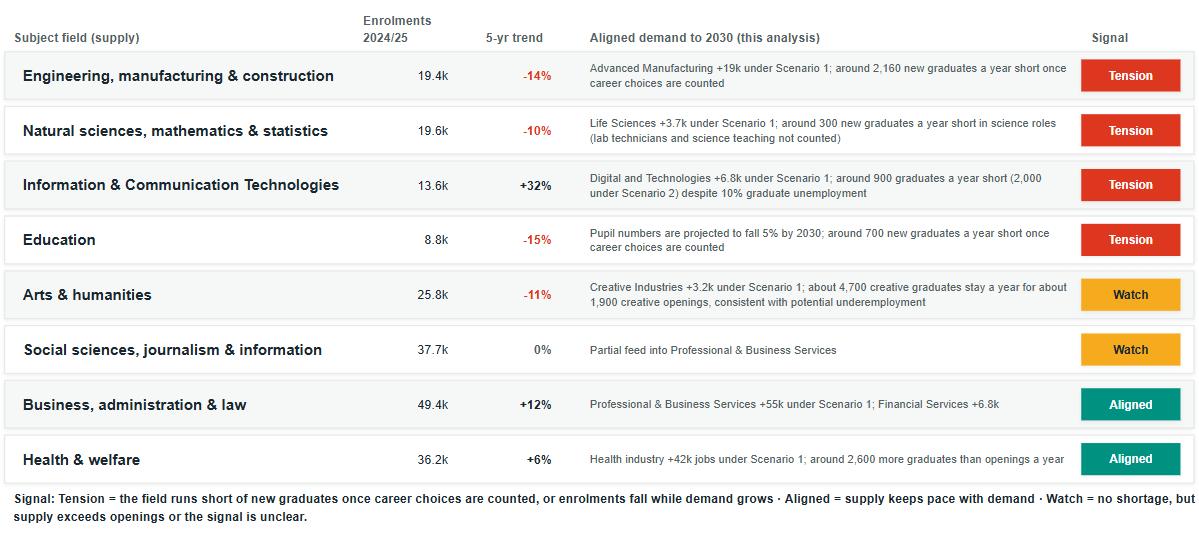
These trends suggest that increasing enrolments alone may not be enough. Universities also need to consider where graduates work after completing their studies and how effectively courses prepare students for regional employment opportunities.
AI could create further opportunities for the regional economy, but it may also increase pressure on graduate supply.
Under the report's AI augmentation scenario, which assumes wider AI adoption and faster growth across the eight Industrial Strategy sectors, Yorkshire and the Humber could gain 379,000 jobs by 2030, including 165,000 degree-level jobs.
However, the annual engineering graduate shortfall would rise from approximately 2,160 to 3,470. Computing shortages would increase from 900 to 2,000 graduates annually, while education shortages would rise from 700 to 1,800.

As demand for skilled workers grows, students will need both specialist knowledge and the skills to adapt to new technologies and work effectively alongside AI.
Addressing these shortages will require closer collaboration between universities, employers and regional policymakers.
The report highlights opportunities to align courses with labour market demand, expand work-based learning and apprenticeships, and develop more flexible opportunities for lifelong learning.
Graduate retention will also be important. Around a quarter of graduates who live in Yorkshire and the Humber leave the region, making stronger local employment pathways an important part of workforce planning.
By using labour market intelligence to inform course development and building stronger employer partnerships, universities can help ensure that regional growth ambitions are supported by the skills needed to deliver them.