.jpeg)
QS World Future Skills Index 2027 - Switzerland Briefing

8 August 2026


Download the full briefing for the complete analysis. Read a few key findings below.
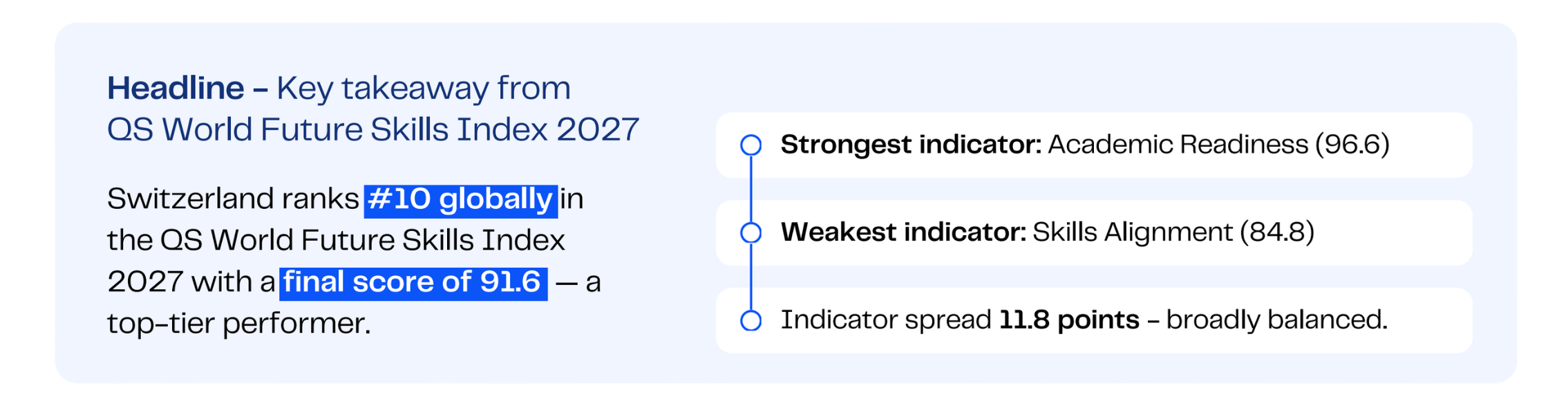
The Switzerland profile shows a highly balanced performance across the four indicators (spread of 11.8 points). Its strongest contribution comes from Academic Readiness (96.6, rank #6), while Skills Alignment is the relative weak spot (84.8, rank #16).
Economic conditions appear supportive, but skills and academic foundations need strengthening to convert that economic capacity into future-ready workforce outcomes.
Peer positioning insight - comparison against regional and income-group cohorts
In its regional cohort (Europe & Central Asia), Switzerland ranks #5 of 37 eligible economies. Its Final Score of 91.6 compares to a regional median of 71.4 (+20.2 vs regional median).
In its income-group cohort (High-income countries), it ranks #9 of 47 eligible economies, with its Final Score +12.9 vs the income group median of 78.7.
The closest regional rival is Spain; the closest income-group rival is Spain.
closest 5 by Final Score within selected economy's region
closest 5 by Final Score within selected economy's income group
The QS World Future Skills Index evaluates how effectively economies can develop, align, and apply skills in a fast-changing global economy. Rather than focusing on higher education only or labour markets in isolation, the Index measures how well higher education systems align with workforce needs in the age of AI.
As economies around the world adapt to the transformative impact of AI, both labour markets and higher education institutions face growing pressure to evolve. Covering 89economies, the Index assesses readiness to harness the opportunities created by AI through a talent-supply and talent-demand analysis. It combines QS’s proprietary data on university performance, jobs and skills, and AI transformation with internationally recognised indicators to provide a global benchmark of AI readiness.
Switzerland ranks 10th globally in the QS World Future Skills Index 2027 with a Final Score of 91.6. Its strongest indicator is Academic Readiness (96.6) due to its performance across QS World University Rankings metrics. However, this is not entirely translating to employer satisfaction – the nation’s weakest indicator is Skills Alignment (84.8), suggesting that the translation of academic excellence into workforce-ready skills remains uneven, pointing to gaps in how effectively graduates are prepared for rapidly evolving labour market demands.
Switzerland’s higher education system underpins a high-value economy, particularly in business (1.4 million employed) and health (627,800 employed), but weakening subject-level reputation signals growing misalignment with industry needs. Median rankings have fallen sharply in business (-308.5 places) and more moderately in life sciences and medicine (-78.5), driven by declines in Citations per Faculty, Academic Reputation, and International Research Network performance. At the same time, Switzerland faces elevated AI automation risk, alongside demographic pressures and reliance on international talent. For a small, advanced economy, the imperative is clear: rebuild internationally competitive subject-level strengths in disciplines that align with strategic industries, ensuring academic excellence translates into workforce-relevant skills and sustained economic value.