
.jpeg)


When focusing on vocational training in the UK, we cannot forget the role of higher education


11 August 2026


The UK education system is expecting a shakeup not seen for years. Writing in The Times in July, the new prime minister spoke about identifying the industries driving growth in local areas and ensuring that young people have a clear route into them and how earlier access to technical training will benefit young people.
However, the current public discourse about young people and education risks overlooking one of the UK’s greatest national assets – higher education.
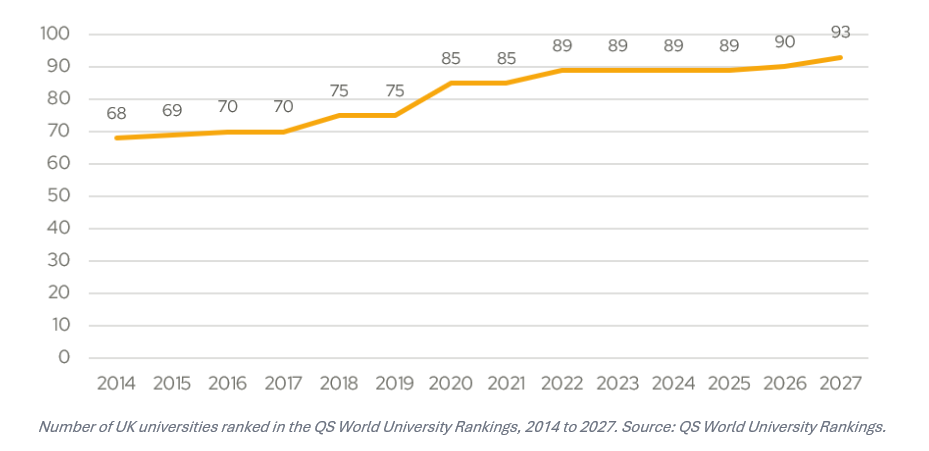
The UK is home to 16 top 100 institutions in the QS World University Rankings 2027, where, with 93 entries, it had its record highest number of entries ever. Very few systems globally perform better than the UK.
And yet, technical education at 14 is a sensible suggestion. At a time of technological advancements and change, the wider the depth of one’s knowledge and experiences will put one in good stead for the future.
And yet too often the wide ranging benefits of higher education are not spoken about.
Research carried out by PWC in 2023 found that the average graduate earns around 57% more than non-graduates, while it also identified strong evidence for a graduate wellbeing premium.
Many of the courses with the largest wellbeing premiums, such as sports sciences and education, have relatively low earnings premiums compared to other courses. Vocational courses in particular, such as nursing, score highly for their wellbeing premiums, PWC found.
More recent research from the Sutton Trust demonstrates a clear association between higher wellbeing and having a degree, regardless of the socio-economic returns.
With 27.5% of degree-educated individuals having high wellbeing compared to 24.7% of those without a degree, the research concluded that graduates tend to be happier than non-graduates. In addition, higher levels of education are consistently linked to longer life expectancy.
And the statistics about financials are still compelling.
The average graduate can expect to be around £100k better off over their lifetime for going to university (this doesn’t mean all graduates will be better off).
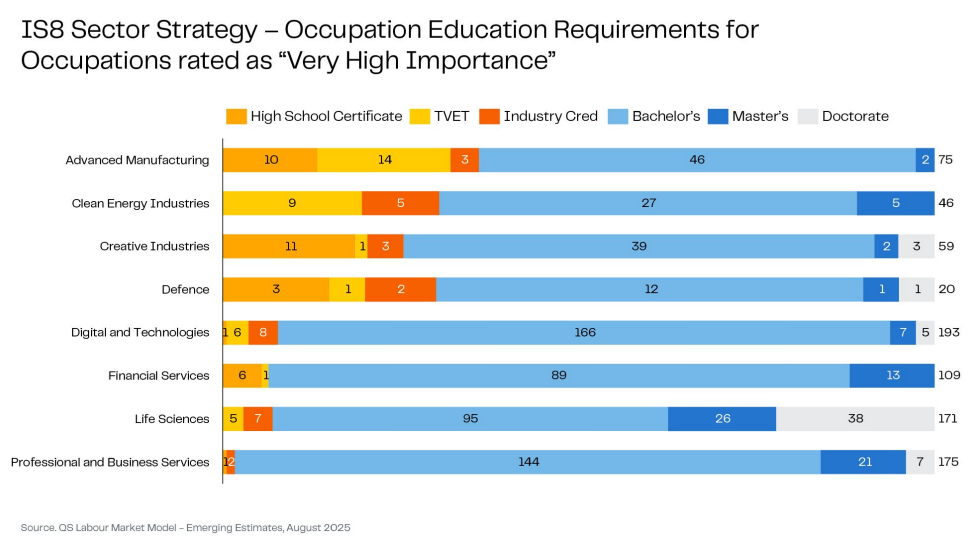
Analysis already carried out by QS, in collaboration with Public First and the University of York, found that over 80% of the occupations most important to the eight Industrial Strategy sectors, laid out by the Starmer government, require a Level 6 qualification or above.
Jessica Turner, CEO of QS, says: “Higher education is well-regarded for improving lives, wages and opportunities, but as QS has found increasingly in recent years, return on investment is crucial. Students want to see their hard work and tuition fees lead to better job prospects, higher wage packets and better standards of life.
"When we consider the future economy, good careers are still expected to require higher education qualifications."
In 2024, the OECD found that nearly four in ten employees in England are overqualified for their jobs, the highest rate among OECD countries.
However, the most recent QS World Future Skills Index shows that the UK has a high density of world-class institutions that offer excellent programmes related to AI, sustainability, and digital skills – areas of industry that are expected to be increasingly important.
And yet, QS also found that higher education is currently well-aligned to industry needs meaning that policymakers should address structural deficiencies in the labour market rather than blaming higher education, as researchers from the Institute of Education at UCL agree.
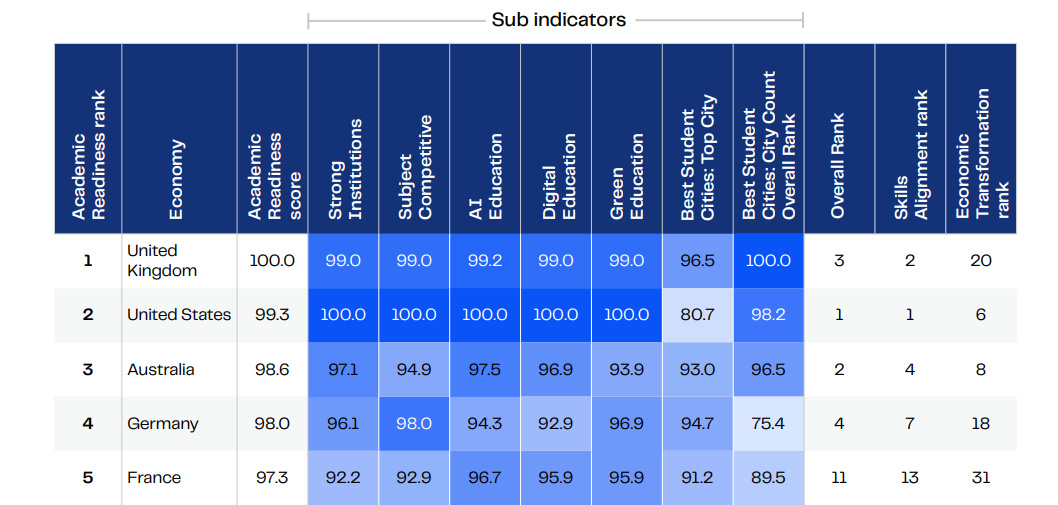
However, the QS research identified that the declining median Employer Reputation rank of UK universities suggests there is growing misalignment between industry and academia.
A priority should be on how the UK takes on emerging industries, while tackling this growing misalignment. For example, what can the UK do around AI innovation to compete with the US or China or emerging tech hubs such as India? How can government radically shift both local and national economies that will be sustained into the future?
According to Universities UK, the UK will require over 1.9 million additional STEM professionals by 2035. Our own analysis that suggests that if UK higher education equips graduates with the necessary AI and other emerging skills required by the labour market, job augmentation is going to be 50% greater than job automation in the UK. This could result in as much as a £490bn GDP premium by 2030.
Where would Silicon Valley be without Stanford? Would we be seeing the same technological innovation coming out of Hangzhou without Zhejiang University as an important talent pipeline? UK policy makers and society need to be thinking how leveraging UK higher education can lead to important jobs and innovation in key sectors for the future that will be globally competitive.
The challenge for the UK’s regions is identifying which areas they have advantages and higher education institutions that will drive economic and social growth.
“The new prime minister rightly talks about reindustrializing the regions and identifying the industries driving growth in local areas,” Turner continued.
“The Industrial Strategy, introduced under his predecessor, was a start, highlighting eight Growth Sectors, each separated into Frontier Industries. But it is unclear whether Burnham’s administration will continue on the 10-year path the plan laid out.
“The Milburn Review also laid out the differences between local economies, highlighting that many regions struggle to generate sufficient graduate level opportunities or wages.”
And the successes of higher education in these areas are also often overlooked.
The Eastern Academic Research Consortium (Arc) in the east of England set out the critical role that universities must play devolution in a report released two years ago, the N8 Research Partnership members are fundamental enablers of growth in the north, the Yorkshire Universities group of 12 institutions already works with local and combined authorities in the region while, according to London Higher, the capital’s higher education sector is worth £60.9bn a year to the economy, thanks to its teaching, research and innovation.
Additional projects such as the Oxford to Cambridge Growth Corridor have been championed by former Minister for Science, Lord Vallance, to become one of the most important innovation zones in the world if business, academia, plus national and local government together work closely together.
“Universities are already deeply embedded in their local towns and cities, employing thousands of people, working with mayoral authorities and local employers and driving positive change,” Turner added.
“If regions such as Cumbria and Lincolnshire see a higher majority of graduates working in jobs that do not require a degree, it is important that these regions are supported with investment in future industries, start-ups are backed and graduates can effectively use their learning beyond their campuses.”
Higher education continually demonstrates that it delivers on growth, innovation, and opportunity.
“The focus on vocational training from an earlier age will bring the UK in line with countries like Germany and the Netherlands, but, as QS research shows, what is important is where those paths lead and how they will open up opportunities in future industries.
“While some 15% of the NEET population has a degree, the number of young people out of work, education or training will not see significant declines, unless employers are encouraged to invest in and give opportunities to young people.”