.jpeg)

QS World Future Skills Index 2027 - India Briefing



26 June 2026


Download the full briefing for the complete analysis. Read a few key findings below.
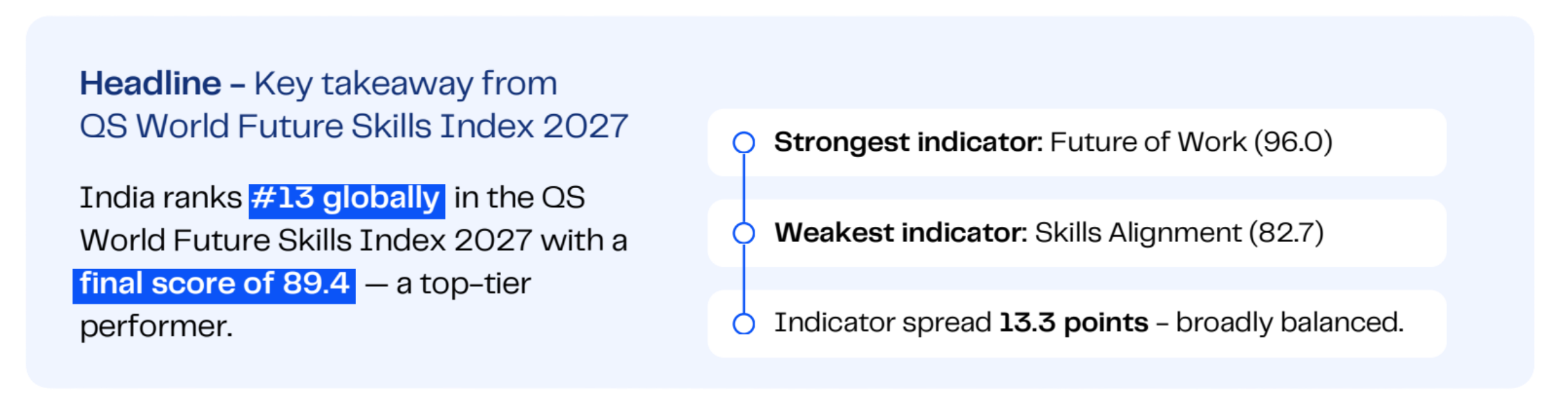
The India profile shows a highly balanced performance across the four indicators (spread of 13.3 points). Its strongest contribution comes from Future of Work (96.0, rank #5), while Skills Alignment is the relative weak spot (82.7, rank #18).
Economic conditions appear supportive, but skills and academic foundations need strengthening to convert that economic capacity into future-ready workforce outcomes.
Peer positioning insight - comparison against regional and income-group cohorts
In its regional cohort (South Asia), India ranks #1 of 4 eligible economies. Its Final Score of 89.4 compares to a regional median of 45.2 (+44.3 vs regional median).
In its income-group cohort (Lower-middle-income countries), it ranks #1 of 18 eligible economies, with its Final Score +46.4 vs the income group median of 43.0.
The closest regional rival is Bangladesh; the closest income-group rival is Philippines.
closest 5 by Final Score within selected economy's region
closest 5 by Final Score within selected economy's income group
The QS World Future Skills Index evaluates how effectively economies can develop, align, and apply skills in a fast-changing global economy. Rather than focusing on higher education only or labour markets in isolation, the Index measures how well higher education systems align with workforce needs in the age of AI.
As economies around the world adapt to the transformative impact of AI, both labour markets and higher education institutions face growing pressure to evolve. Covering 89economies, the Index assesses readiness to harness the opportunities created by AI through a talent-supply and talent-demand analysis. It combines QS’s proprietary data on university performance, jobs and skills, and AI transformation with internationally recognised indicators to provide a global benchmark of AI readiness.
India ranks 13th globally in the QS World Future Skills Index 2027 with a Final Score of 89.4. Its economy has quickly shifted to realise the potential gains AI and digital transformation offer, with high performance across the Index’s demand-side indicators (Future of Work 96, Economic Transformation 93.2). The question, then, is whether Indian higher education can produce the highly-skilled graduates its domestic industry requires at scale.
The elite tier of institutions (IITs, IIMs, AIIMS) are globally competitive, but majority of Indian institutions produce graduates at volume but with far lower employability rates; this employer dissatisfaction materialises in India’s comparatively low Skills Alignment score (82.7, lower than any top 10 nation). The NEP 2020 reform agenda is structurally sound but implementation is uneven across states and institution types.
The central paradox: India produces the largest outbound flow of international students in the world, simultaneously exporting its most talented graduates and struggling to employ the remainder domestically. The headline for India is that it scores well on system scale, demographic potential, and outbound mobility, but poorly on skills alignment and quality consistency. A core part of the solution must be transnational education; India has the ingredients to be the fastest-growing economy of the next decade, but its limited domestic higher education capacity will limit the supply of future-ready talent. To accelerate the supply of high-quality graduates, India must leverage its increasingly welcoming policy environment, and existing demographic and economic strengths, to attract international partners.