
.jpeg)


QS World University Rankings: Asia 2025
6 November 2024


Note: This analysis covers the QS World University Rankings: Asia 2025. For the latest results and analysis, explore the QS World University Rankings: Asia 2026.
Peking University ranked first in the QS World University Rankings: Asia 2025, followed by the University of Hong Kong, National University of Singapore (NUS) and Nanyang Technological University, Singapore (NTU).
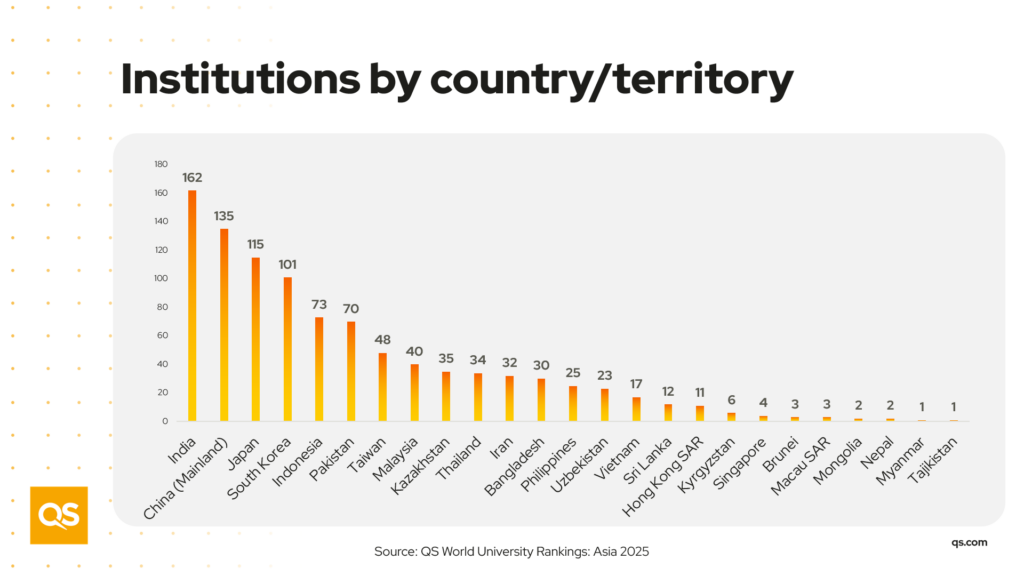
The 2025 rankings assessed 984 institutions across 25 locations in Eastern, Southern, South-Eastern and Central Asia, providing a regional view of university performance across Asia.
Three institutions break into the top 20:
Several institutions made significant gains in the QS World University Rankings: Asia 2025. The Hong Kong Polytechnic University, Hanyang University and Universiti Putra Malaysia entered the top 20.
Malaysian universities recorded several of the largest improvements within the top 100. Sunway University rose from joint 103rd to 74th, Universiti Utara Malaysia moved from 101st to joint 79th, UCSI University climbed from joint 61st to 45th, and Universiti Teknologi PETRONAS rose 16 places to joint 53rd.
143 institutions entered the QS World University Rankings: Asia for the first time in 2025. The Education University of Hong Kong was the highest-ranked new entrant at joint 212th, with strong performance in Faculty Student and Citations per Paper. Woosong University (ranked 541- 560th) earned the top score in International Faculty among the new entries.
China has four institutions in the top 10, 10 in the top 50, and 22 in the top 100. Beijing Institute of Technology moved up 29 places to 64th, making it China’s most improved institution. China’s average indicator score is strongest in research related indicators, Citations per Paper, Papers per Faculty, and International Research Network.
There are 35 institutions ranked from Kazakhstan – three universities are listed in the top 100: Al-Farabi Kazakh National University ranked 29th, L.N. Gumilyov Eurasian National University (ENU) ranked 65th and Satbayev University ranked 89th. Al-Farabi Kazakh National University attained the highest scores in the country in key indicators including Employer Reputation, Academic Reputation and Faculty Student.
India has two institutions in the top 50 and seven in the top 100. Indian Institute of Technology Delhi (IITD) is the highest ranked institution at 44th. The most improved Indian institution is University of Petroleum and Energy Studies (UPES), which moved up 70 places to 148th, thanks to its improvements in nine out of 11 metrics – most prominently International Research Network, Citations per Paper and Papers per Faculty. India’s average indicator score is strongest in Papers per Faculty and Staff with PhD.
The QS World University Rankings: Asia 2025 features 23 institutions from Uzbekistan – Tashkent Institute of Irrigation and Agricultural Mechanization Engineers - National Research University (TIIAME-NRU) is the only university in the country to reach the top 200 in the rankings overall, moving from =249 to 159th. Additionally, the institution is Asia’s most improved university as they increased their scores in 10 out of 11 metrics, including Faculty Student, Employer Reputation and Academic Reputation.
Hong Kong has three institutions in the top 10, five in the top 50 and six in the top 100 overall. The biggest climber is City University of Hong Kong, moving from 17th place in the previous year to 10th – the University has notably increased its Faculty Student Ratio and Papers per Faculty. Hong Kong’s average indicator score is strongest in Citations per Paper and International Faculty and International Student Ratios.
Japan has nine institutions in the top 50 and 13 in the top 100, while 21 Japanese universities debuted in the QS World University Rankings: Asia 2025. The University of Tokyo is Japan’s highest ranked institution at 21st. The biggest climber is Sophia University, moving up 22 places to =212th, due to notable increases in Faculty Student Ratio and Exchange Student indicators. Japan’s average indicator score is strongest in Staff with PhD.
South Korea has one institution in the top 10, eight in the top 50 and 15 in the top 100. Yonsei University is the highest ranked Korean institution at 9th. The biggest climber is Inha University, which moved up 11 places to 116th, with the most significant improvements in five indicators such as Faculty Student Ratio, Academic Reputation and Citations per Paper. Korea’s average indicator score is strongest in Staff with PhD and Faculty Student Ratio.
Malaysia has seven institutions in the top 50 and 10 in the top 100. Universiti Malaya (UM) is Malaysia’s highest ranked institution at 12th. The biggest climber is INTI International University, which moved up 52 places to 170th due to significant improvements in Academic Reputation, Faculty Student Ratio, Papers per Faculty, Staff with PhD and International Research Network indicators. Malaysia’s average indicator score is strongest in International Faculty Ratio, International Student Ratio and Inbound Exchange Students.