

.jpeg)


Malaysia’s next global test: Turning international student growth into reputation advantage

30 June 2026


Surging demand; global contender; a leading hub for international education. These are all words used to describe Malaysia in the past year.
Its rise must now go beyond student recruitment, with Malaysia’s reputation and graduate employment the next focus areas as it transitions from a challenger-nation, into a true, sustainable international student destination.
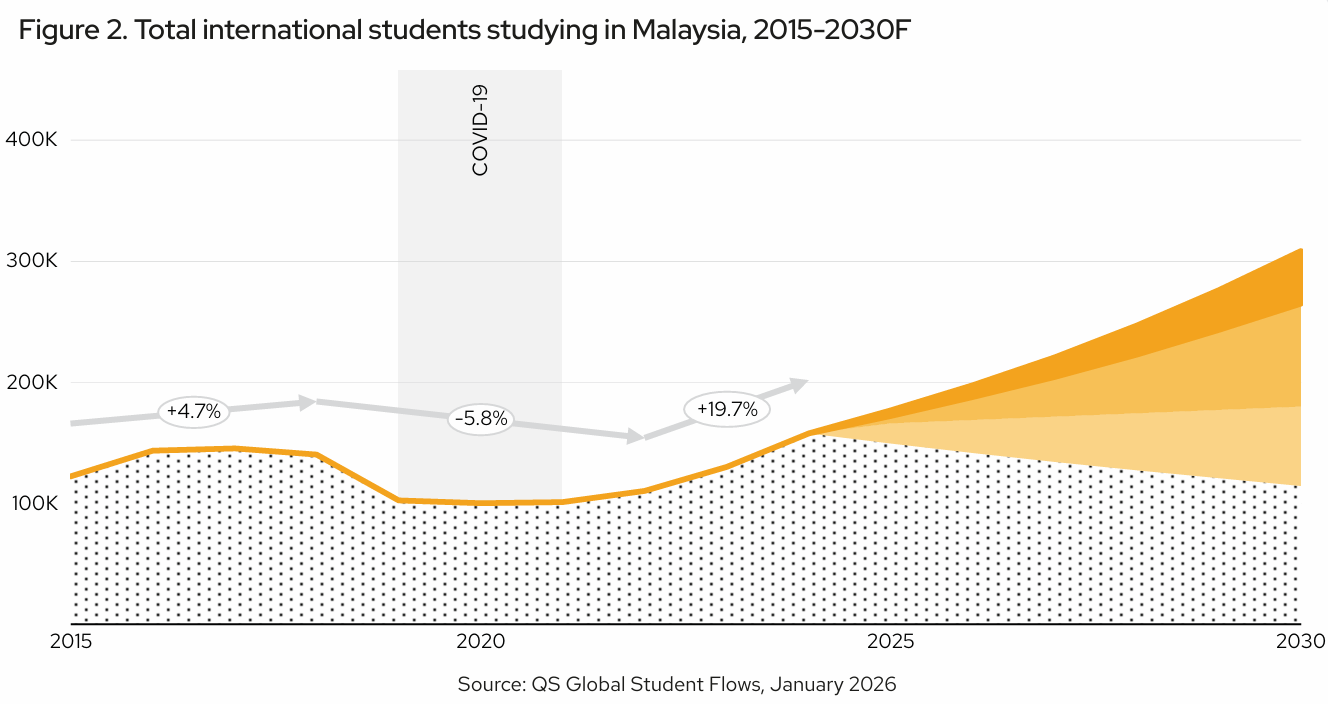
In Global Student Flows: Malaysia, we argue that Malaysia is “rapidly establishing itself as a leading global hub for international education”, supported by affordability, cultural diversity and a robust transnational education ecosystem. We forecast average annual growth of 8.5% in Malaysia’s international student numbers through 2030, with enrolments projected to reach around 260,000 by 2030, up from 160,000 in 2024. Visa applications grew by more than 20% in 2024 for the third consecutive year, suggesting demand is going beyond mere post-pandemic recovery, and into a new reality. Private universities account for nearly 70% of international enrolments, while Malaysia’s branch campus and partnership models allow students from markets such as Indonesia, Pakistan and Bangladesh to access global credentials at lower cost. But the factors that have driven this first phase of growth may not be enough to sustain it.
Malaysia’s next phase will be defined by a different set of expectations. Affordability and access have attracted a first wave cost-sensitive students, but institutional reputation will determine whether Malaysia can compete sustainably with the ‘Big Four’ study destinations and other emerging Asian rivals. 55% of students looking to study in Malaysia say reputation is important when choosing a university. However, the average reputation of a Malaysian institution has stagnated since 2017, making academic recognition, employer trust and graduate outcomes central to the next growth cycle.
This shift is already becoming visible at the institutional level. Sunway University offers a clear example. Over the past five years, it has improved its position in the QS World University Rankings by 330 places and lifted its Academic Reputation ranking by more than 400 positions, and is now among the top 10 universities in Malaysia. Sunway University is also ranked #55 in the QS World University Rankings: Asia Region 2026.
Since 2016, Malaysia has added 24 institutions to the QS World University Rankings, which is a clear signal of intent to increase higher education capacity. But quality is also rising, with four Malaysian institutions entering the top 250 of the QS World University Rankings between 2016 and 2027. As we note in How universities are shaping ASEAN’s tomorrow, “Malaysia’s consistency points to a well, developed higher education system with strong international engagement.” In the QS World University Rankings 2027, we see a decline in the number of ranked institutions across many ASEAN countries but, even still, Malaysia’s dip is smaller.
As the market matures, student expectations are shifting accordingly. The students Malaysian institutions want to attract are asking sharper questions about return on investment, graduate employability and career outcomes. However, the employability of graduates is not the sole responsibility of universities – if there are no roles for skilled talent to work in, they will go elsewhere.
In the QS World Future Skills Index 2027 – which measures how ready an economy is for an AI augmented labour market – Malaysia places #36 globally. It scores strongly for Skills Alignment, reflecting years of investment in higher education, technical training and digital capability, but parts of the labour market are still concentrated in occupations less exposed to high-value AI augmentation; without jobs for highly skilled talent to work in, the workers will leave for economies where they can achieve higher salaries.
Malaysia’s continued success will rely on a symbiotic relationship between industry and higher education policy to ensure the workforce is ready for the influx of highly skilled talent graduating from Malaysia’s higher education institutions.
The challenge is to ensure that Malaysia’s value proposition does not become trapped in a “low-cost alternative” narrative. Malaysia’s strongest institutions must show that affordability can coexist with research quality, international faculty, strong student outcomes and employer recognition.
Malaysia has demand, demographics, regional relevance and a compelling affordability advantage. What it must now build is reputation at scale. If Malaysian universities can turn student growth into employer confidence, research collaboration and globally recognised outcomes, Malaysia will not merely benefit from shifts in global student mobility. It will help define the next generation of international education hubs.







.webp)