
.jpeg)


What is a skills gap? Understanding hard, soft and technical skills
29 August 2024


A skills gap occurs when there is a mismatch between the skills employers need and the capabilities available in the workforce. Skills gaps can affect organisations of all sizes, making it more difficult to recruit talent, achieve business objectives and adapt to changing market demands.
For universities and students, understanding skills gaps is increasingly important. As industries evolve and new technologies emerge, employers are looking for a combination of hard skills, soft skills and technical skills that prepare graduates for long-term success.
At QS, we measure skills gaps through global employer research and labour market intelligence, helping institutions better align educational outcomes with workforce needs.
A skills gap is the difference between the skills employers need and the capabilities available in the workforce. It occurs when employee skills do not meet employer expectations.
At QS, we measure this by asking thousands of employers in the QS Global Employer Survey about which skills they perceive to be important, and their satisfaction level with those skills.
A skills gap is a challenge for students and employers. Skills gaps can affect productivity, recruitment, innovation and long-term economic growth.
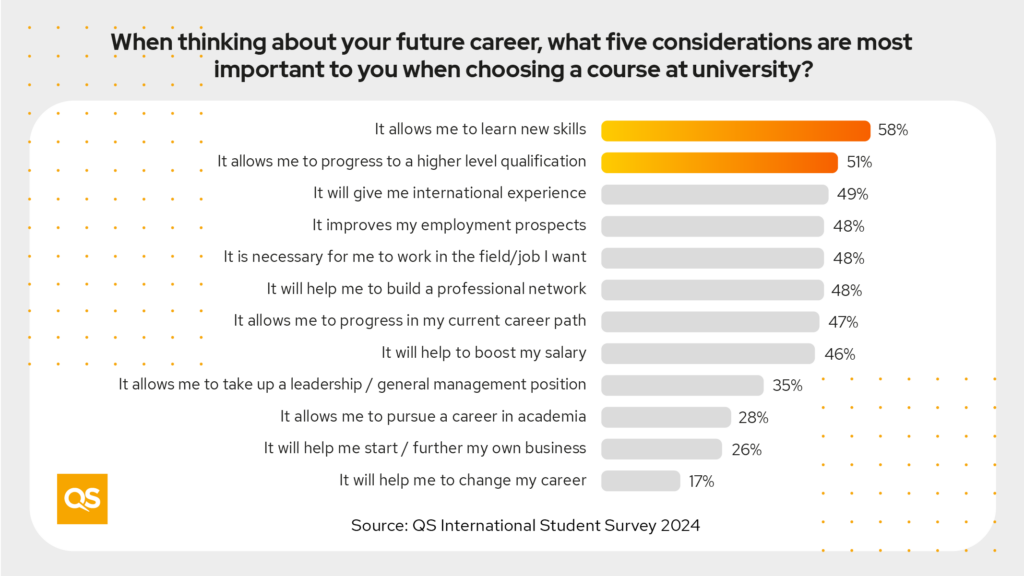
Among many other reasons, students choose to go to university to develop their skillset in preparation for work and the rest of their lives. In the QS International Student Survey 2024, we found that students saw upskilling as an important career consideration when choosing a university course.
Speaking at the QS Higher Ed Summit: Middle East 2024, Dr Christine Looser, Senior Academic Director at Minerva Project, said: “When you think about our purpose as educators, it really has to be about preparing students for an uncertain changing world.”
For employers, skills gaps are troublesome in a different way. According to a 2023 report from Skillsoft, C-suite level staff reported skills gaps causing: increased stress on existing employees; increased project durations, slower resolution times; decreased ability to meet business objectives, and more. “All of these outcomes have very serious dollar amounts associated with them,” the report adds.
Nadia El-Gowely, Executive Director at Al-Fanar Media, speaking at QS Reimagine Education 2023 summarised the current skills gap landscape perfectly: “The skills gap is very much alive in the minds of students, universities, employers, and policymakers. It might sound like a trendy conversation, but for good reason – for globalisation, automation and technological advancements taking place at dizzying speeds.”
There are lots of ways to visualise skills gaps. Here is just a snapshot of the data we collect through our QS Global Employer Survey, and QS 1Mentor – our AI-driven career navigation and employability insights platform.

The above chart shows skills gaps reported by employers in countries across the Asia Pacific region. The darker the square, the larger the disparity between a skills’ perceived importance and employers’ satisfaction with that skill. Showing the data in this way, we can see some trends arising. Teamwork, for example, is a consistent skills gap across Asia Pacific. Communication, however, is different – the skills gap is more strongly perceived in Eastern and South-eastern Asia.

Alternatively, we can look at the overall largest skills gaps per region, or globally. The above bar chart again shows skills gaps reported by Asia Pacific employers. Problem solving has the largest skills gap – this is true in Asia Pacific, whose score you can see with the blue bar, and globally, which is indicated by the horizontal black line.
This view also shows us disparities, and enables us to make actionable recommendations for universities in Asia Pacific. For example, Asia Pacific’s universities are outperforming the global average in communication skills and emotional intelligence.
Universities are underperforming in more areas – skills gaps in creativity, leadership, negotiating skills and sales, language skills, and sustainability mindset are all more pronounced in Asia Pacific than the global average.
With this in mind, our recommendation would be to embed these specific skills into the curriculum to better align university programmes with employer needs.
Employers use a variety of methods to assess whether candidates possess the skills required for a role. These commonly include interviews, technical assessments, portfolio reviews, work simulations, assessment centres and practical exercises.
Increasingly, organisations are adopting skills-based hiring approaches that focus on demonstrated competencies alongside academic qualifications. Understanding how employers evaluate skills can help universities design programmes that better prepare students for the workplace and help graduates communicate their capabilities more effectively.
What skills can you measure?
The QS Global Employer Survey splits skills into two groups: comprehensive skills and emerging skills.
Comprehensive skills can be seen in the charts above. They are the skills that almost all employers seek in employees. They are, very often, transferrable skills.
Emerging skills are skills that are increasingly identified by employers, but are not as transferrable or as ubiquitous. Examples include data analysis, app development & gaming, blockchain, and design.
With QS 1Mentor, we can be even more specific. Using the platform, we can also explore hard skills, such as C++, AutoCAD, Python, Mechanical Engineering, data analytics, tableau, budget management and Microsoft Excel. We also gather data on human skills, like teamwork and communication. We can also align this skills gap data with specific occupations – communications for a sales person is very different to communication skills for a data scientist.
By assessing such a broad range of skills, we have a comprehensive picture of the labour market. We can use this data to recommend specific actions a university can take to update their curriculum. Through 1Mentor, students can support graduates looking for jobs using this same data.
When discussing skills gaps, it is important to distinguish between hard skills, soft skills and technical skills. Employers increasingly evaluate candidates across all three categories when assessing workplace readiness.
Soft skills are transferable interpersonal capabilities that help individuals work effectively with others and navigate workplace challenges. Examples include communication, teamwork, leadership, adaptability, emotional intelligence and problem solving.
Hard skills are measurable abilities that can be developed through education, training and professional experience. Examples include project management, budget management, research methods, data analysis and foreign language proficiency.
Technical skills are specialised competencies linked to particular occupations, technologies or industries. Examples include Python, Tableau, AutoCAD, cloud computing, mechanical engineering and artificial intelligence.
As industries evolve, demand for technical skills can change rapidly, making continuous upskilling increasingly important.
Employers rarely hire based on a single skill category. Technical expertise may be essential for performing a role, but soft skills and hard skills are often what enable employees to collaborate, innovate and progress in their careers.
For universities and students, understanding the relationship between these different skill types is an important part of addressing skills gaps and improving graduate employability.
Skills gaps are constantly evolving as technology, automation and employer expectations change. Emerging fields such as artificial intelligence, data science and digital transformation are creating demand for new technical skills, while employers continue to place significant value on communication, leadership, creativity and critical thinking.
As a result, universities face the challenge of balancing specialist technical knowledge with broader employability skills. By monitoring labour market trends and employer feedback, institutions can make more informed decisions about curriculum design and graduate outcomes.
Data is necessary to support curriculum design. Understanding the labour market and the current perception of your institution are key components of an employability strategy. With the right data, students can be supported to make decisions about their degree, courses and microcredentials based on market needs. This is particularly important when addressing gaps in hard skills, soft skills and technical skills, all of which play a role in graduate employability.
Information about what skills employers are looking for can also give additional context to graduates looking for a job. For example, if they see an emerging skills gap in Javascript, which they could through QS 1Mentor, they could then take a course to upskill and upgrade their CV.