.jpeg)


QS World University Rankings: Europe 2026 results
28 January 2026


The QS World University Rankings: Europe 2026 is now live! In this edition, we have ranked over 950 institutions across Europe using 12 performance indicators. 42 countries and territories are represented.
To ensure these Rankings are as relevant as possible to European institutions, we have used a different selection of indicators. This approach enables direct comparisons within the region, offering a more granular view of metrics for institutional benchmarking and helping students identify the highest quality universities.
With a score of 100/100 in five indicators, the University of Oxford leads the Ranking. Following significant improvements in our Sustainability and International Student Ratio indicators, the University of Oxford overtook ETH Zürich and Imperial College London. ETH Zurich dropped in our Inbound and Outbound Exchange Students indicators, and the Faculty-Student Ratio indicator. Meanwhile, Imperial College London saw a more significant drop in Papers per Faculty, alongside our two Exchange Student indicators.
Between rank 11 and 20, there was significant volatility, with no institution maintaining the same rank. Big improvers include Delft University of Technology, which is now 11th (previously 15th) and Ludwig-Maximilians-Universität München, and the University of Warwick which moved from 21st and 22nd respectively to =17th.
This Ranking uses different indicators to the QS World University Rankings 2026. This is to highlight Europe's unique characteristics as a regional ranking. Different indicators include:
Over 290 universities are newly ranked this year. The top new entrant is City St George’s, University of London (127th). Otto-von-Guericke-Universität Magdeburg placed =321s in its inaugural ranking, with TUHH Hamburg University of Technology placing at =336th.
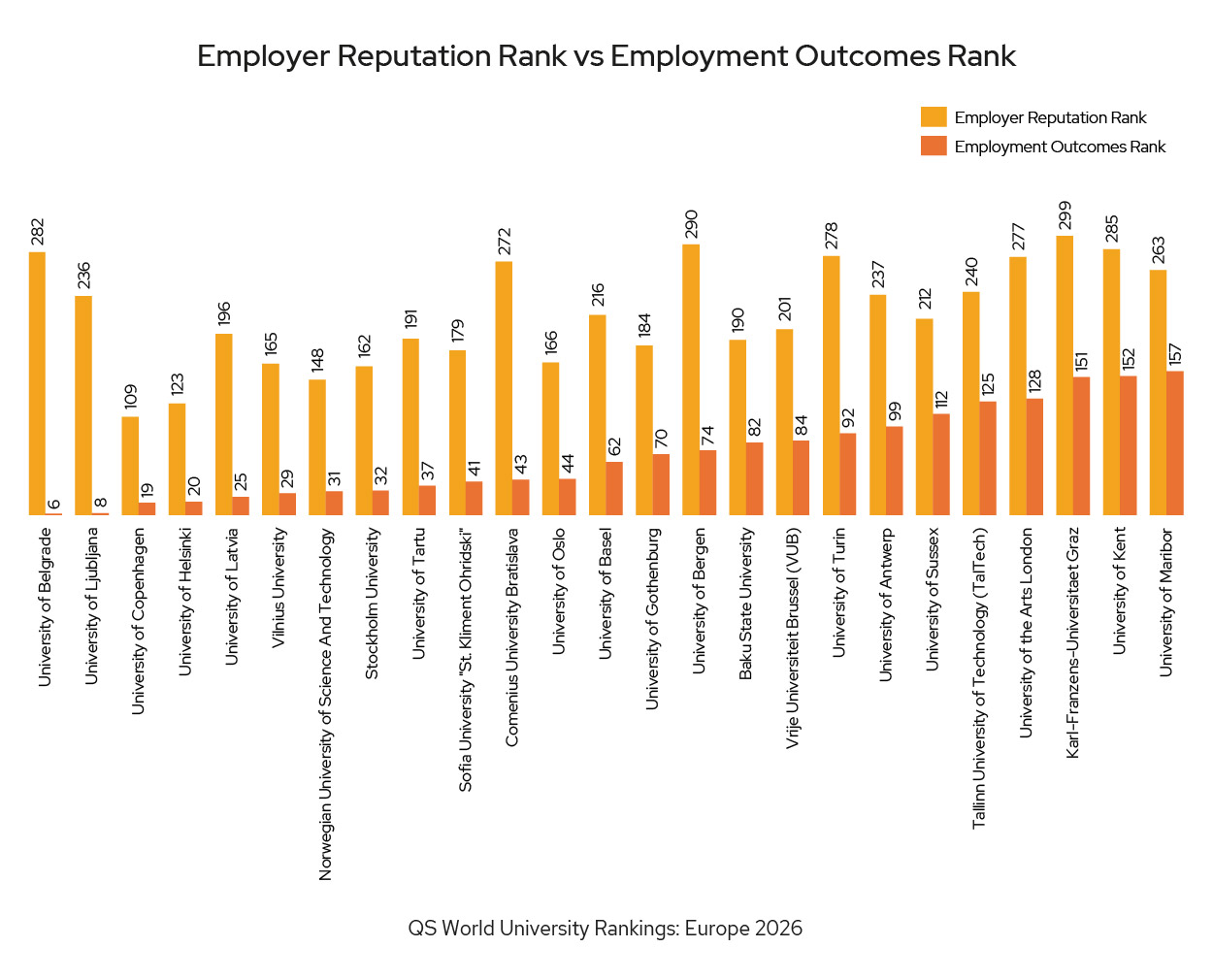
Employability is clearly a key focus for European institutions. Employment Outcomes is typically the strongest indicator for institutions, with an average score of 43/100; 24% of institutions improved their Employer Reputation rank.
The University of Oxford is top for Employer Reputation, followed by the University of Cambridge and Imperial College London. Institut Polytechnique de Paris is fourth, making it the first non-UK university in this indicator.
In our Employment Outcomes indicator, the University of Oxford again takes top spot. However, the University of Cambridge is second, followed by The London School of Economics and Political Science (LSE). This dissonance between Employer Reputation and Employability Outcomes suggests that, for the University and Cambridge and LSE, there is work to be done to promote the excellence of their graduates and shore up their Employer Reputation. The same applies to the institutions outlined below, who have the largest disparity between their Employment Outcomes rank, and their Employer Reputation rank.