
.jpeg)


Global Student Flows | Africa - Outbound trends



4 March 2026


In brief:
Download the full report now for all the insights.
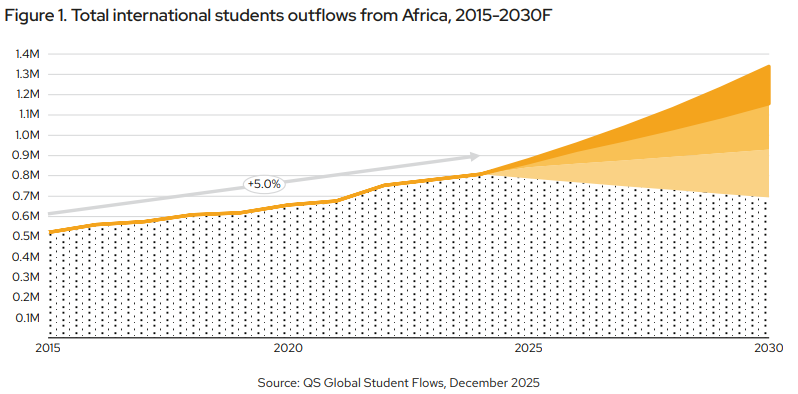
The number of outbound students from Sub-Saharan Africa is expected to grow by around 5% annually, increasing student numbers to over 1 million by 2030, driven by a rapidly expanding youth population. Over the last 10 years, the number of outbound students from Africa rose steadily, surpassing 800,000 in 2024, reflecting growing demand for international education and limited higher-education capacity across the continent.
Africa has the world’s youngest population, and its 18-25 age group is expected to grow by around 3% annually until 2030, the highest growth rate of any region globally. This is increasing the demand for higher education, fuelling increased outbound student mobility.
Nigeria has consistently sent more students abroad than other African countries, with 2024 sending over 125,000 students. In 2023, the number reached its highest level in a decade at around 140,000, driven by currency devaluation, frequent university strikes, and ongoing security concerns that make foreign education a preferred option despite rising costs for Nigerian students. Countries such as Morocco, Egypt, Algeria, and Cameroon have also shown high outbound mobility.
Nigeria, Morocco, and Egypt remain Africa’s top student sources, with Nigeria’s large cohort of around 126,000 students, Morocco’s steadily rising 77,000, and Egypt’s 50,000 contributing to roughly 31% of the continent’s outbound total. Their combined scale and consistent growth show how just a few major senders continue to shape Africa’s overall mobility trends.
Nigeria alone represents 15% of Africa’s outbound volume, with growth fueled by underfunded universities, limited domestic course capacity, and economic instability. Morocco reflects a mature Francophone corridor, supported by ties to France and Belgium, rising middle-class investment, and government-backed pathways. Egypt’s renewed outward mobility is driven by overcrowded universities, oversubscribed STEM and medical programmes, and more affordable destinations like Turkey, Malaysia, and Eastern Europe.