

.jpeg)


The ‘Asian Tigers’ of international study in Asia and the rise of emerging destinations
.png)
18 December 2025


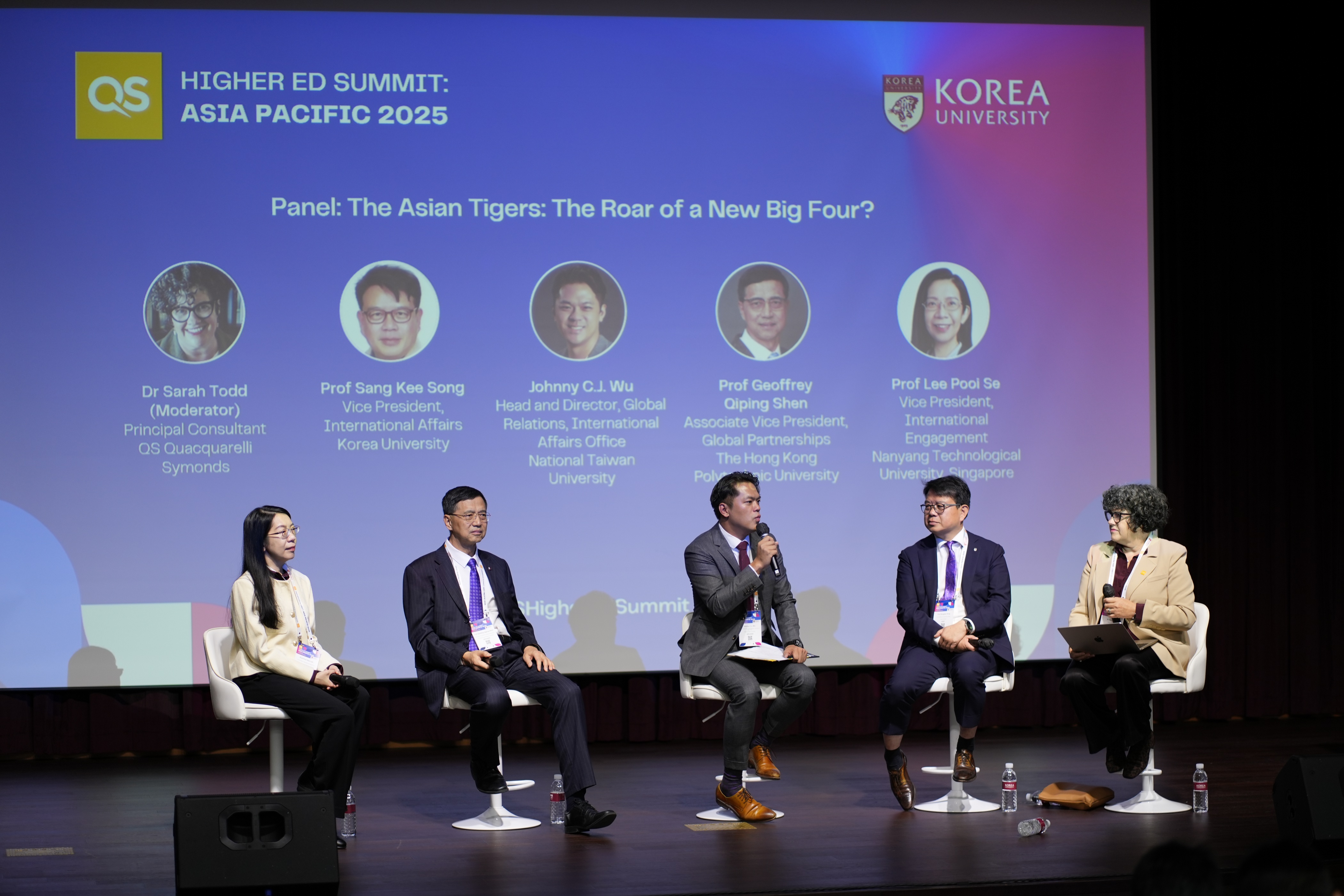
At QS Higher Ed Summit: Asia Pacific 2025, Dr Sarah Todd, Principal Consultant at QS, was joined by panellists from Asia’s ‘tiger’ destinations: Taiwan, Hong Kong, Singapore and South Korea to discuss the rise of international student recruitment in the region. The Asian tiger destinations are seeing unprecedented numbers of international student intake and may eventually rival the success of the ‘Big Four’ destinations: the US, the UK, Canada and Australia.
Reports such as the Global Student Flows report and QS World University Rankings: Asia 2025 show that these four destinations have already achieved success; particularly when it comes to intra-regional international student recruitment from countries such as Japan, Mainland China and India. Furthermore Seoul, South Korea’s capital, ranked first in the QS Best Student City Rankings 2026. A longstanding welcoming environment and high-quality universities mean that these Tiger destinations have, for many students, become the first choice.
South Korea has met its international student recruitment target two years in advance. When asked about their motivations for exceeding this target and recruiting as many students as possible, Professor Sang-Kee Song, Vice President of International Affairs at Korea University, outlined issues that his country was facing regarding low birth rates. Song believed that international student recruitment is the best way to address the problem.
Aside from increasing the number of students and working professionals in South Korea, Song also claims that more international students will bring more diversity to Korean society which, Song noted, is traditionally very homogenous. Song claimed that the recent popularity of Korean media was also helping to solve the problem of language barriers as many international students already spoke some Korean. He claimed 70% students had at least an intermediate command of the language, meaning they were able to speak well and integrate into the community. This general level of language proficiency is reflected in the programmes that Korea University offers. According to Song, 60% of the programmes at KU are taught in Korean and 40% are taught in English. “We have a two-track strategy for recruiting: [the 70% who speak Korean] who are eager to study at KU and then, after graduation, they want to work in Korea. And then another 30% [who do not speak Korean] who want to build their career and get their education in Korea and then they want to go to graduate school [elsewhere].”
Singapore has a longer history of success in international student recruitment and recognises the importance of attracting international talent. Professor Pooi See Lee, Vice President of International Engagement and the spokesperson for Singapore’s Nanyang Technological University, said “Singapore is a cosmopolitan city nation and it’s very essential for us to have talent.” She argued that Singapore provides a “global setting with English as the main medium of instruction [in universities] and the main official language in conducting business and economic activity.” Due to its position as an international trade hub, Singapore is often considered a ‘gateway’ to Asia for international students.
Lee claimed that Singapore’s most notable strength when recruiting international students is its employment prospects and the opportunity for long-term residence. This is supported by the views of a prospective international student from Nigeria, who was quoted in the QS International Student Survey expressing interest in Singapore “because of the reputation they have built over the years in my preferred choice of study (civil engineering) and the quality of teaching.”
Hong Kong can also be considered a ‘gateway to Asia’ due to its long history of expats, historic ties to the UK and international corporate bases.
Professor Geoffrey Shen, Associate Vice President of Global Partnerships at Hong Kong Polytechnic University described Hong Kong as “a city where the East meets the West.” He commented “Over the years there has been a tremendous increase in the number of applications” to PolyU. International students from other Asian countries have been a notable part of this increase as he reflected on the fact that “Hong Kong is also a popular destination for Korean students.”
From his observations, the reasons why students are choosing Hong Kong as a study destination include their wide variety of university programmes taught in English and their campuses in the heart of the city. The geopolitics of other countries leads them to reject valuable applicants while, in contrast, the Hong Kong government has relaxed the limit on international student intake. Previously, only 20% of a cohort at a Hong Kong university could be international, then 40% and, as of 2025, 50%. A prospective student from Mainland China offered their perspective in the QS International Student Survey as they were quoted saying “Hong Kong is an international city and finance centre. The education system is roughly similar to that of Britain, and you can experience a different cultural education.”
When asked about international student recruitment in Taiwan, Johnny Wu, Director of the Global Relations and International Affairs Office at National Taiwan University explained, “it’s not that we need to [increase international student recruitment], it’s that we’re forced to.” Taiwan also faces the pressures of an ageing population and a shrinking workforce with growth of only 0.5% per decade. “Taiwan cannot rely solely on domestic cohorts to sustain innovation and keep up with sector demand. Universities therefore become the front line for replenishing talent,” Wu said.
This opinion is also reflected in government policy. Taiwan aims to have at least 320,000 international students by 2032 and enrolment statistics show that they are making notable progress as, prior to the COVID-19 pandemic, only 8% of the student cohort were international student -now that number is 18%.
When discussing Taiwan’s approach to recruiting international students, Wu said, “it’s a very important moment for us, not only Taiwan but all the Asian countries, to think about what else we can do, not only to recruit, not only to educate, but also to retain.” He emphasises the importance of language and making sure that a Taiwanese education is accessible to students who do not speak Mandarin: “if our environment is not friendly enough, not like Singapore or Hong Kong which is English-speaking , when you have South Korea in Korean, Japan in Japanese and Taiwan in Mandarin, how can they survive?”
The international student recruitment policies adopted by Asian countries directly contrast the government policies of the ‘Big Four’ destinations. When asked if there were any concerns about these more liberal policies looking to the future, Lee expressed the
importance of regular reviews to ensure that they remained beneficial and functional. “I think it’s a balance based on feedback from universities as well as community and society in order to make an informed policy. Especially on the university front, where there is an increase in enrolment we would have to cater for capacity.”
She continued, “In my university, we are taking a very balanced and planned approach because we also don’t want to compromise the quality of the student experience.” With student experience as a cornerstone of the decisions being made around student recruitment, Lee suggests that Nanyang Technological University’s efforts to diversify classrooms and achieve a balance between international and domestic students contributes to a more positive experience for everyone. Their aim is to integrate the students effectively and make sure that there is not a divide or a different experience for one type of student or another.
Similarly, in a video welcoming the panellists and speakers for the conference, the Mayor of Seoul talked about South Korea being ranked the 2026 best student city by QS. He said that Seoul was encouraging of international students and recognised the contributions that they are making to society. Professor Sang-Kee Song explained that the government had taken a very liberal approach as the Ministry of Education in South Korea is usually in charge of tuition prices and the number of university places available to domestic students but with international students, they had created a completely free market. Song explained that this was an exciting opportunity for Korean universities as “without the control of the Ministry of Education we can design a new curriculum and new study areas for international students.” He went on to explain the university’s plans to implement programmes specialising in global entertainment, AI and engineering which he hoped would attract many more international students.
Song emphasised that he saw the increase in numbers of international students not as a potential issue but as an opportunity for growth and diversifying international student intake. To do this, Korea University has established new scholarships for African, South American and Eastern European students. “By diversifying the student body, our domestic students can be more equipped for global leadership.”
Language is another common concern when it comes to international students. On one hand, programmes taught in English would make Asian education more accessible to students from all over the world, but Todd also cited the examples of Denmark and the
Netherlands who have cut back on their English-taught university programmes for fear of losing their national language.
Wu explained that he was not worried about this and saw English-taught programmes as a valuable way to expand Taiwan’s higher education system and other industries: “Thanks to semiconductor industries [which Taiwan is famous for], a lot of students are coming to Taiwan not only to learn Mandarin but also to develop their professional skills in this ecosystem, everything related to semiconductors” Teaching a wide variety of programmes in English has allowed National Taiwan University to expand its offerings for international students beyond just language studies. It has allowed them to include international talent in some of its most well-known industries to further develop the economy.
When asked about their focus and unique strengths in comparison to other Asian study destinations, each of the ‘Asian Tiger’ destinations had a different perspective. Shen spoke about the emerging technologies and technological development that are incorporated into every programme at Hong Kong Polytechnic University. AI, data analytics and entrepreneurship are important skills that all students at the university develop regardless of their subject choices.
Lee said that Nanyang Technological University’s strengths are in teaching quality, student experience and research excellence which is used to address industry needs.
Wu said that an innovative curriculum and research were also important in Taiwan with the addition of industry connections. He said “four years ago, National Taiwan University launched a programme called the Global Mentorship Programme which was exclusively designed for international students. We recruit more than 140 companies and assign more than 300 mentors and open more than 350 job vacancies and internships.”
Finally, Song spoke about Korea University’s flexible curriculum and the integration of subject specific studies with language studies and contextual studies which ensure that international students have the same experience as domestic students.
South Korea, Hong Kong, Taiwan and Singapore have increased international student recruitment by focussing on their curriculums, creating a welcoming policy environment, developing English-taught programmes and providing excellent student support. Despite the challenges that they continue to face, they are pioneering a new approach to international student recruitment and are offering students attractive options for international study outside of the ‘Big Four’.







.png)