

.jpeg)


The US Higher Education Market Landscape in 2026

.png)
23 April 2026


Summary
The United States remains a higher education leader, with nearly 19.5 million students studying in US colleges in 2024. However, with the US study-age population projected to flatline, there is limited scope for growth from domestic enrollments alone, meaning institutions cannot rely on arising tide of home-grown applicants to sustain revenue or fill seats.
We are already seeing the effects: college enrollments fell4% between 2015 and 2024, as demographic shifts and a declining perceived value of a college degree began to take hold. For institutions that have not yet diversified their recruitment strategies, the window to act is narrowing.
Africa and the Asia Pacific region are forecast to see population increases, and these regions have historically driven strong enrollment flows to the US. The broader South Asian region is emerging as a primary source market, with Bangladesh, Nepal, and Pakistan all registering strong year-on-year increases.
This represents a genuine growth opportunity, but one that requires a different playbook. These markets typically exhibit higher price sensitivity, according to the QS International Student Survey, which means competing on prestige alone will not be enough. Institutions will need to align their financial aid, scholarship messaging, and value proposition to what students in these markets actually value.
The US enjoys excellent performance across the QS World University Rankings, with the nation accounting for 26% of the top 100 ranked institutions. This global standing remains a foundational asset for driving international enrollments - but it is not a fixed one.
Reputation - a key metric in the QS World University Rankings - is strongly tied to international recruitment decisions, as seen below. Students consistently point to it as the most important factor when choosing a university: 54% cite reputation as important when selecting a course, and 69% cite it as important when choosing a university overall. For European students considering the US, that figure rises to nearly 80%. In other words, rankings position does not merely influence perception, it directly shapes application behavior.
This makes the current trend particularly significant. Many US institutions are seeing a decline in their reputation scores, particularly in Academic Reputation. Left unaddressed, these declines translate into a measurable recruitment disadvantage, especially as competition from UK, Australian, and European institutions continues, and competitors across Asia emerge.
Even so, US institutional reputation - and QS World University Rankings position - remains stronger than that of other 'Big Four' destination countries. That advantage still exists, but it should not be treated as permanent. For institutions willing to invest in understanding and communicating their global standing, there is a clear point of leverage. Learning how to maximise the impact of a strong reputation will be a defining competitive factor through to 2030 and beyond.
As noted, international student enrollments in the US are forecast to decline. In the Global Student Flows: United States report, published by QS, these trends are explored in detail.
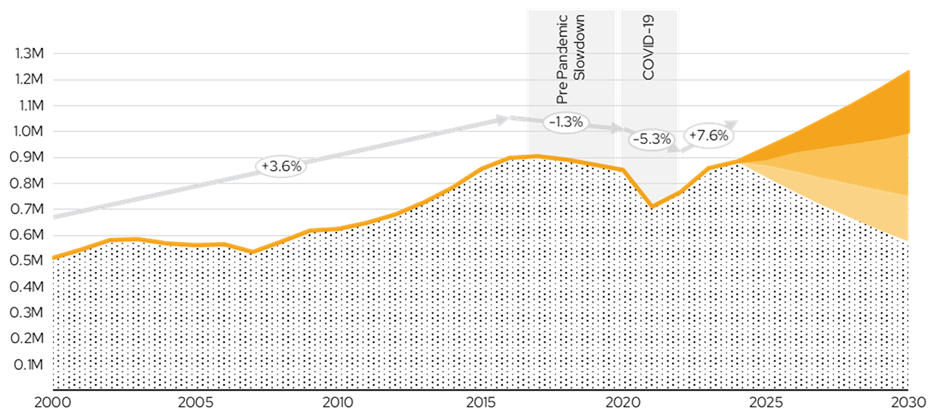
The US's reliance on China and India - its two largest source markets - will decrease further. The UK is projected to overtake the US as the largest destination for international students by 2030. For US institutions, this is not a distant concern: the competitive reordering is already underway, and market share lost during this period may be difficult to recover.
Growing share in emerging markets means understanding what students in those markets are actually prioritising. The data below illustrates how those priorities vary - and why a one-size-fits-all approach to international recruitment is unlikely to succeed.
Across industries, QS Labor Market Intelligence estimates many job roles can be augmented by AI – up to 60% in the technology industry. To future-proof graduate skills, it’s key that universities embed skills to develop AI competency within their programs, regardless of major. This only becomes more important when we look at AI automation vulnerability by industry.
With many roles forecast to be automated by AI – particularly across mobility, environment, defense and technology – universities that don’t act will be preparing graduates for roles that won’t exist in the future. This makes it imperative that US colleges work closely with industry to ensure their curricula is relevant and aligned to business-needs.







.png)